

The Catalyst Club Think Tank · Policy Paper No. 02
Rebuilding Nepal’s
Enterprise Economy
A Legislative & Fiscal Reform Agenda for SMEs,
Startups and Entrepreneurs, 2026–2031
Eighty-five percent of Nepal’s labour force works in enterprises that no institution is mandated to defend. This paper sets out the statutory, fiscal and institutional reforms required to convert that neglected majority into the engine of a production-and-export economy — before the demographic window closes.
| 923,356 ENTERPRISES | 85% OF LABOUR FORCE | $3.56B FINANCING GAP | <1% FDI / GDP | 26.6% REMITTANCE / GDP | 32 RECOMMENDATIONS |
Compiled by
Dr. Prabhat Adhikari, MD (physician) · Er. Anup KC, Chemical Engineer
CA Bishnu Bhandari, FDI Expert · Dr. Narayan Ghimire, PhD (Senior Advocate)
Contributors Kamal Parajuli · Amrit Bista · Subrat Sitaula · Hari Joshi
The Catalyst Club Think Tank, Nepal | catalystxclub.com
August 2026 | Kathmandu
Submitted to the Rt. Hon. Prime Minister, the Hon. Deputy Prime Minister and Minister of Finance, and the Council of Ministers, Government of Nepal.
Contents
Table of Contents
| 1 | Executive Summary and Schedule of Recommendations |
| 2 | The Diagnostic: Nepal’s Enterprise Economy in Numbers |
| 3 | Institutional Architecture: A National SME & Startup Authority |
| 4 | Classification Reform: Foreign-Exchange Earners versus Drainers |
| 5 | Access to Capital: Project-Based Finance and Risk Sharing |
| 6 | The Foreign Investment Regime: A Clause-by-Clause Review of FITTA 2075 |
| 7 | Non-Resident Nepalis: The Constitutional and Economic Case |
| 8 | Innovation, Incubation and the University–Industry Interface |
| 9 | Tariff Inversion and the Contract Manufacturing Opportunity |
| 10 | Energy Pricing for Industry |
| 11 | Intellectual Property, Standards and Certification |
| 12 | Credit Discipline: The Case for a Prompt Payment Act |
| 13 | Export Promotion and Market Access |
| 14 | Technology Sovereignty: Compute, AI and the Knowledge Economy |
| 15 | Taxation: Widening the Base, Rebalancing the Burden |
| 16 | Meritocracy and HDI-Based Inclusion |
| 17 | The Demographic Constraint |
| 18 | Implementation Sequence and Performance Framework |
| A | Annex A — FITTA 2075 Schedule: Full Negative List |
| B | Annex B — Key Statutory Provisions Quoted |
| C | Annex C — Draft Legislative Instruments Proposed |
| D | References |
Scope and method
This paper is a policy analysis prepared by The Catalyst Club Think Tank. It builds on our Nepal’s Strategic Economic Roadmap & 20-Year Development Vision (March 2026) and narrows its focus to the enterprise layer of the economy — micro, small and medium enterprises and innovation-stage startups. Every statutory reference has been verified against the consolidated text published by the Nepal Law Commission. Statistical claims are sourced to the National Statistics Office, Nepal Rastra Bank, the Ministry of Finance, and named multilateral publications; all sources are listed at Annex D. Where we present projections or illustrative figures, they are labelled as such. We have deliberately separated what the law currently says from what we recommend it should say, so that any reader may contest our recommendations without disputing our description of the present position.
Section One
Executive Summary
Nepal does not have a small business problem. It has a small business policy problem. The enterprises that employ 85 percent of the labour force operate under a legal and fiscal architecture designed for a different economy — one built on importing goods and exporting people. This paper identifies twelve structural defects in that architecture and proposes thirty-two specific corrections, sequenced by whether they require executive action, primary legislation, or new fiscal commitment.
The central finding
Nepal’s policy settings systematically reward the movement of goods and systematically penalise their creation. A trader who imports a finished product faces lower duty, needs no plant, hires few people, requires no certification, obtains bank credit against land, and repatriates value in a single transaction cycle. A manufacturer or service exporter doing the economically superior thing — adding domestic value and earning foreign exchange — faces higher input duty, uncompetitive power tariffs, no project-based credit, no certification pathway, no enforceable right to be paid on time, and no export promotion machinery. The market is responding rationally to the incentives the state has created. The problem is the incentives.
0.05% — the share of Nepal’s estimated US$3.56 billion MSME financing gap that the government’s flagship subsidised startup credit programme actually disbursed in a full fiscal year (Rs 190.4 million to 165 enterprises).
The twelve structural defects
| # | Defect | Consequence | Instrument required |
| 1 | No dedicated institution for SMEs and startups | 85% of the labour force has no statutory advocate; FNCCI/CNI structurally represent larger incumbents | New statute |
| 2 | No policy distinction between FX earners and FX drainers | Identical treatment produces identical outcomes; capital flows to trading | Executive + Finance Act |
| 3 | Banks lend against land, not projects | Innovation without collateral is unbankable; the financing gap persists at $3.56bn | NRB directive + guarantee fund |
| 4 | FITTA s.3(3) minimum foreign investment floor of Rs 20 million | Small and diaspora capital legally excluded; FDI below 1% of GDP | Gazette notification |
| 5 | FITTA Schedule (negative list) closes 11 broad sectors | Agriculture, cottage industry, tourism services and consultancy shut to foreign capital and technology | Gazette notification under s.50 |
| 6 | NRNs classified as foreign investors | 2.2 million Nepalis abroad face the same gate as strangers | Statutory amendment |
| 7 | No incubation network; no university–industry interface | Skills mismatch; graduates trained for an economy that exists elsewhere | Budgetary |
| 8 | Inverted customs duty on raw materials | Manufacturing is priced out of its own domestic market | Finance Act |
| 9 | Industrial power tariffs uncompetitive despite surplus | Nepali factories cannot match Indian or Bangladeshi cost bases | NEA tariff order |
| 10 | No functioning IP, patent or certification infrastructure | An idea that cannot be owned cannot be financed or exported | Statute + accreditation |
| 11 | No credit law governing commercial payment terms | Small suppliers fail from cash-flow strangulation, not lack of demand | New statute |
| 12 | No export promotion, trade intelligence or barrier-response capacity | 86 tea factories closed in 2026 when a single import rule changed abroad | Institution + budget |
What can be done immediately, at no fiscal cost
Four of our recommendations require neither new legislation nor new money. They can be executed by Gazette notification, ministerial directive or administrative order within ninety days:
Ninety-day executive package
• Repeal the Rs 20 million foreign investment floor. Section 3(3) of FITTA empowers the Government to fix this threshold by Gazette notification. What was fixed by notification can be unfixed by notification. No parliamentary time is required.
• Issue an NRN investment circular. Section 3(3) expressly permits differential thresholds for non-resident Nepalis. The enabling power already exists and has never been exercised in the diaspora’s favour.
• Commission and publish a customs inversion audit. Identify every tariff line where input duty exceeds output duty; correct them in the next Finance Act.
• Direct that all enterprise subsidies flow exclusively through the banking system. An administrative instruction to line ministries, effective immediately, removing discretionary cash disbursement.
The binding constraint is time, not consensus
Nepal’s total fertility rate has fallen from 4.6 children per woman in 1996 to approximately replacement level; 2.2 million Nepalis lived abroad at the 2021 census; over 207,000 workers departed for Gulf states in six months of a single recent fiscal year; and youth unemployment stands near 21 percent. The demographic dividend that Nepal has been promised for two decades is being consumed faster than it is being earned. Reforms that are correct but late will be measured against a labour force that has already gone.
Section Two
The Diagnostic: Nepal’s Enterprise Economy in Numbers
Policy discussion in Nepal routinely refers to SMEs as “the backbone of the economy.” The phrase is used so often that it has stopped conveying information. This section restates the position quantitatively, because the scale of the enterprise layer is the single strongest argument for the institutional reform proposed in Section 3.
2.1 The shape of the enterprise base
The National Economic Census 2018 enumerated 923,356 establishments in Nepal. Of these, 95.5 percent were micro enterprises, 4.2 percent small, and the residual — approximately 0.3 percent — medium and large combined. Only about half of all establishments were formally registered. This is not a pyramid with a broad base; it is a plateau with a statistical rounding error on top.
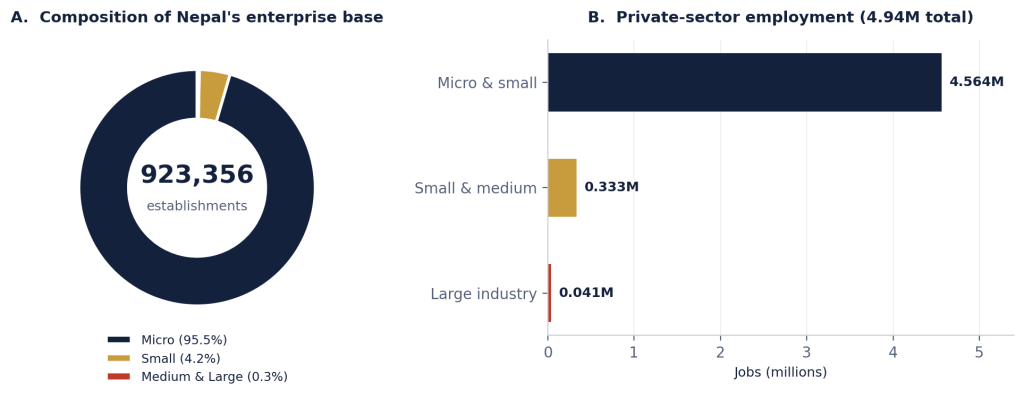
Figure 1. Composition of Nepal’s enterprise base and the distribution of private-sector employment. Panel A: establishment counts, National Economic Census 2018. Panel B: private sector employment of 4.94 million persons, equal to 85.6 percent of the total labour force. Note the asymmetry — large industry accounts for 0.3 percent of establishments and 0.8 percent of private jobs, yet commands a disproportionate share of policy attention, credit allocation and chamber representation.
Three consequences follow from this distribution. First, any policy instrument designed around firms with audited accounts, collateralisable fixed assets and dedicated compliance staff will, by construction, reach fewer than five percent of Nepali enterprises. Second, aggregate employment outcomes in Nepal are determined almost entirely by what happens to micro and small firms; large-industry policy is, in employment terms, a rounding exercise. Third, the productivity ceiling of the Nepali economy is the productivity ceiling of its small firms — and that ceiling is set by their access to capital, technology, standards and markets.
2.2 The financing gap
The United Nations Economic and Social Commission for Asia and the Pacific has estimated Nepal’s MSME financing gap at approximately US$3.56 billion. Against this, the Government’s principal instrument — the subsidised startup enterprise credit programme administered by the Industrial Enterprise Development Institute under the Startup Enterprise Loan Operation Procedure 2082 — recommended 183 enterprises and actually disbursed Rs 190.4 million to 165 of them in the reference fiscal year, against a budget allocation of Rs 730 million (IEDI having itself requested Rs 1 billion).
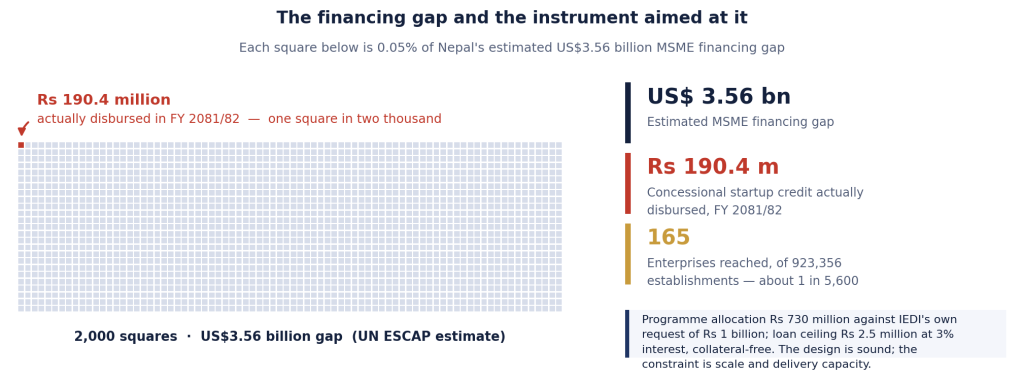
Figure 2. Scale mismatch between the estimated MSME financing gap and actual concessional disbursement. Each of the 2,000 squares represents 0.05 percent of the gap; the single red square is the amount actually disbursed. We emphasise that the programme’s design is sound — collateral-free, 3 percent interest, project-as-security — and that our criticism is exclusively one of scale and delivery capacity, not of principle.
A design flaw worth naming
Reporting in June 2026 indicated that a material share of earlier concessional startup borrowers ceased operations after disbursement, prompting the tightening of eligibility to a minimum 50-mark evaluation threshold under the amended Startup Enterprise Credit Operation Procedures 2082. We support merit-based selection. But the underlying failure was not borrower quality alone: a Rs 2.5 million ceiling is below the working-capital requirement of most manufacturing or hardware startups, which forces founders to under-capitalise and then blames them for failing. Raising selectivity without raising ticket size will produce fewer, equally under-capitalised failures.
2.3 Capital: what Nepal imports, and in what form
Nepal is not short of foreign exchange. It is short of foreign investment. Remittance inflows have consistently exceeded a quarter of gross domestic product — one of the highest ratios recorded anywhere — while foreign direct investment has never exceeded one percent of GDP. The country therefore imports capital in the form of wages earned by absent citizens, rather than in the form of equity that builds productive capacity at home. Wages are consumed; equity compounds.
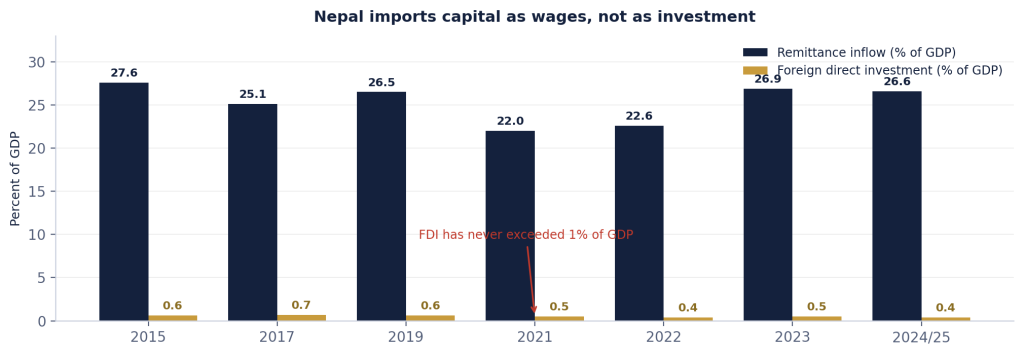
Figure 3. Remittance inflows and foreign direct investment as a share of GDP. Remittance figures from World Bank and Nepal Rastra Bank series; FDI share from national accounts. The comparison is the central macroeconomic fact of modern Nepal: a sustained current-account subsidy from labour export, paired with a near-total failure to attract productive foreign capital. Section 6 argues that the second half of this picture is substantially a consequence of statutory design.
2.4 The demographic constraint
Every reform proposed in this paper is time-limited in its value, because the population it is designed to employ is shrinking and departing simultaneously. Nepal’s total fertility rate fell from approximately 4.6 children per woman in 1996 to about 2.1 by 2022, and continues to decline. Approximately 2.2 million Nepalis were resident abroad at the 2021 census. The Government’s own population policy discussion has acknowledged negative population growth and has publicly encouraged earlier marriage and larger families.
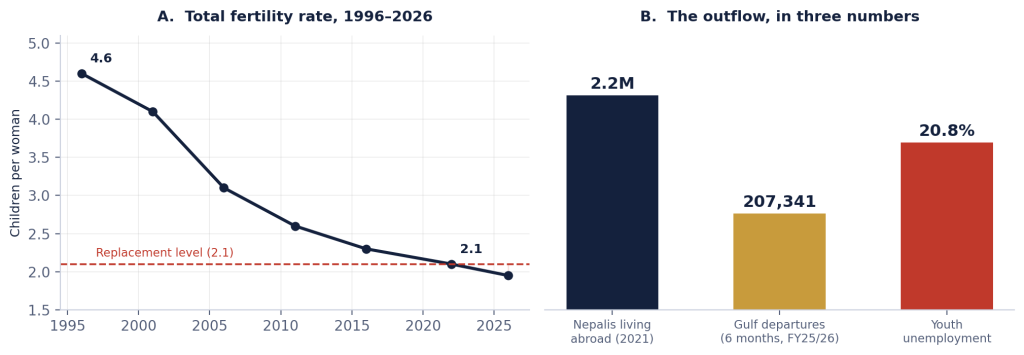
Figure 4. Panel A: total fertility rate 1996–2026, showing the crossing of the replacement threshold. Panel B: three measures of outflow and labour underutilisation. Bar heights in Panel B are indexed for visual comparison, not to a common numeric scale; the printed values are the data. Sources: UNFPA Nepal, National Statistics Office, Department of Foreign Employment.
The policy implication is not sentimental but arithmetical. A demographic dividend is a window during which the ratio of working-age persons to dependants is favourable. Nepal has been told it holds a twenty-year window. Between falling births and accelerating emigration, that window is closing materially faster than the projections on which national planning documents were built. Reforms delayed by three years are not reforms delivered three years late; they are reforms delivered to a smaller and older workforce.
Section Three
Institutional Architecture: A National SME & Startup Authority
Nepal’s enterprise majority has no institution whose survival depends on its survival. This is the root defect from which several others follow, because in the absence of a dedicated statutory advocate, SME interests are represented only incidentally, by bodies whose primary constituency lies elsewhere.
3.1 The representation gap
The Federation of Nepalese Chambers of Commerce and Industry and the Confederation of Nepalese Industries are competent, long-established institutions that have contributed substantially to Nepal’s economic policy discourse. We make no criticism of their conduct. We make an observation about their structure: the membership economics of any chamber weight its agenda toward its largest fee-paying members. That is not a defect of character; it is a property of the organisational form. The consequence is that issues which are existential for a fourteen-person dairy in Kavre — delayed receivables, certification access, a Rs 800,000 credit requirement — do not compete successfully for institutional attention against issues that are material for a large importing house.
Comparative practice is instructive. India operates a dedicated Ministry of Micro, Small and Medium Enterprises with statutory backing under the MSMED Act 2006. Malaysia operates SME Corporation Malaysia as a central coordinating agency. South Korea maintains a Ministry of SMEs and Startups with cabinet rank. In each case the institution was created precisely because chamber representation had proved structurally insufficient.
3.2 Recommended design
Recommendation 1 — Establish a National SME & Startup Authority by statute
The Authority should be created by primary legislation, not by executive order or as a department within the Ministry of Industry, Commerce and Supplies. Departmental status produces a body whose budget, staffing and priorities are set by officials whose primary accountability lies elsewhere. Specifically:
• Governance. A board of not more than eleven members, of whom at least six shall be practising owners or founders of enterprises meeting the statutory SME or startup definition, appointed for fixed non-renewable terms through an open, published process. Chamber nominees should hold no more than two seats.
• Mandate. Registration and classification of SMEs and startups; administration of concessional credit and guarantee instruments; certification and standards facilitation; grievance escalation with statutory response deadlines binding on other agencies; and an annual State of Nepali Enterprise report laid before Parliament.
• Instrument. The Nepal Enterprise Facility announced in the FY 2083/84 budget should be vested in the Authority as its principal financing vehicle, rather than established as a parallel structure.
• Accountability. Statutory obligation to publish, quarterly and in machine-readable form, the number of enterprises registered, credit disbursed, grievances resolved within deadline, and jobs attributable to supported firms.
Recommendation 2 — Codify a single statutory definition of “startup”
Nepal currently operates overlapping definitions across the National Startup Enterprise Policy 2081, the Startup Enterprise Loan Operation Procedure 2082, and the Industrial Enterprises Act 2076. We propose consolidation on the following criteria, which broadly follow our March 2026 Roadmap: incorporation within the preceding ten years; annual turnover not exceeding Rs 150 million; fixed capital excluding land and buildings not exceeding Rs 20 million; demonstrable novelty in product, service, process or business model; and explicit exclusion of purely import-and-resale operations and blacklisted entities. A single definition, applied across tax, credit and procurement, removes the arbitrage and confusion that currently attends multiple regimes.
Section Four
Classification Reform: Foreign-Exchange Earners versus Drainers
Nepal’s fiscal architecture does not distinguish between an enterprise that earns foreign exchange and one that spends it. Both are taxed, licensed, credited and regulated on materially identical terms. The predictable result is that capital flows to whichever activity offers the higher risk-adjusted return — which, under current settings, is trading.
4.1 The economic logic
Consider two enterprises of equal capital. Enterprise A imports finished consumer goods and distributes them domestically. It requires no plant, employs few people, needs no certification, faces a single working-capital cycle, and can secure bank credit against the proprietor’s land. Enterprise B manufactures a comparable good in Nepal for export. It requires plant and machinery, employs perhaps thirty people, must obtain product certification, must comply with labour and environmental regulation, faces an input duty that may exceed the duty on Enterprise A’s finished import, pays an industrial power tariff that its regional competitors do not, waits ninety to one hundred and eighty days to be paid, and cannot borrow against a purchase order.
Enterprise B is unambiguously superior from the standpoint of national income: it adds domestic value, generates employment, creates transferable skills, and earns rather than consumes foreign currency. Under present policy it is also the worse commercial decision. No amount of exhortation about patriotic entrepreneurship will alter an arithmetic that the state itself has authored.
Both are legitimate.
Trading is a lawful and necessary economic function, and this paper proposes no restriction upon it. We propose only that the state stop pretending the two activities have identical consequences for the national balance sheet — and that it price them accordingly.
4.2 Recommended mechanism
Recommendation 3 — Introduce a statutory Net Value Contribution classification
Every registered enterprise above a de minimis threshold should be assigned an annual classification based on two measurable variables already captured in existing tax and customs filings:
• Net foreign exchange position — export receipts and import-substituting output, less imported inputs, as a proportion of turnover.
• Domestic value addition — turnover less the landed cost of imported goods and services, as a proportion of turnover.
Enterprises should fall into four bands (A through D). The classification requires no new data collection; it is a computation over information the Inland Revenue Department and the Department of Customs already hold.
Recommendation 4 — Tier every incentive to the classification
Concessional credit eligibility, credit guarantee coverage ratios, industrial power tariff bands, customs clearance priority, land allocation in industrial estates and special economic zones, public procurement preference margins, and corporate tax concessions should each be graduated by band. Band A enterprises — high net foreign exchange earners with high domestic value addition — should receive first call on every constrained public resource. This is not protectionism; no enterprise is excluded from any market. It is the ordinary practice of aligning public subsidy with public return.
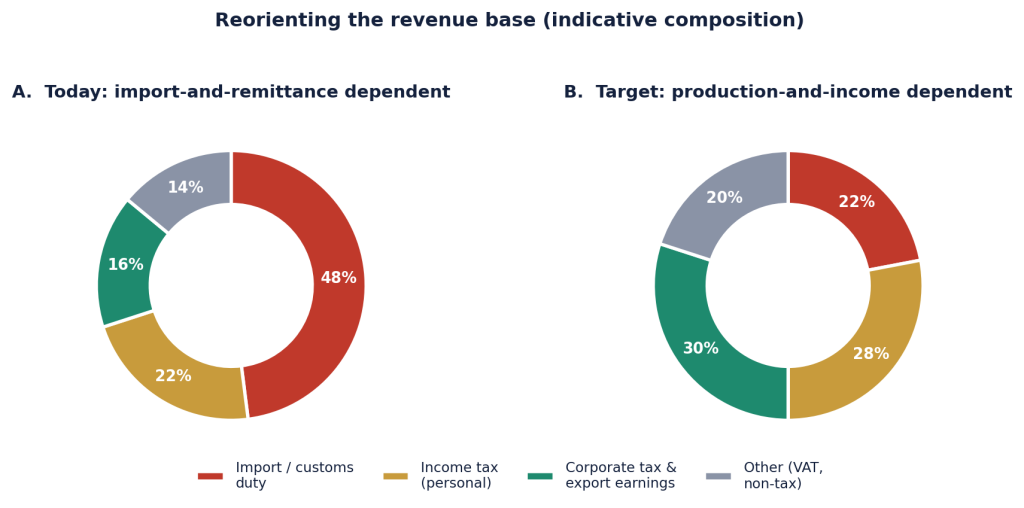
Figure 5. Indicative reorientation of the government revenue base. Panel A approximates the present composition, dominated by customs duty on imports and by consumption taxes funded substantially from remittance income. Panel B shows the target composition for a production-and-export economy. Percentages are illustrative of direction and relative weight, not published forecasts. The policy point is structural: a state that raises revenue principally by taxing imports has a fiscal interest in continued import dependence.
Section Five
Access to Capital: Project-Based Finance and Risk Sharing
Nepali commercial banks lend against land. This single practice, more than any other, determines who is permitted to build a business in Nepal — and it selects for inherited property rather than for commercial merit.
5.1 The collateral trap
A founder holding a signed export order, verified purchase commitments, defensible intellectual property and a credible cash-flow model is, in the ordinary Nepali banking system, unbankable. A founder holding ancestral land in an urban municipality and no business plan is bankable. The system is not corrupt in producing this outcome; it is rational under the risk-weighting, provisioning and recovery framework within which banks operate. Correcting it therefore requires changing that framework, not appealing to bankers’ patriotism.
It should be acknowledged that Nepali law already contemplates project financing. Section 12 of FITTA expressly permits industries to contract project loans and project financing arrangements with foreign financial institutions with Nepal Rastra Bank approval, and permits the mortgaging of immovable property to such institutions. The Startup Enterprise Loan Operation Procedure 2082 explicitly treats the project proposal as security. The statutory foundation exists. What is absent is a domestic banking directive that makes project-based assessment routine rather than exceptional, and a risk-sharing instrument that makes it commercially rational.
FITTA 2075 — Section 12(1) & 12(4) · Project loans
१२. विदेशी वित्तीय संस्थाबाट ऋण लिन सक्ने: (१) कुनै पनि उद्योगले प्रचलित कानून बमोजिम नेपाल राष्ट्र बैङ्कको स्वीकृतिमा विदेशी वित्तीय संस्थाबाट परियोजना ऋण (प्रोजेक्ट लोन) वा परियोजना लगानी (प्रोजेक्ट फाइनान्सिङ) सम्झौता गरी ऋण लिन सक्नेछ।
“Any industry may, with the approval of Nepal Rastra Bank and in accordance with prevailing law, obtain a loan from a foreign financial institution by concluding a project loan or project financing agreement.” Sub-section (4) further permits such an industry to mortgage immovable property in favour of the foreign lending institution. Note: sub-section (5) excludes industries listed in the Schedule (negative list) from this facility entirely — a compounding restriction discussed at Section 6.4.
5.2 Recommended instruments
Recommendation 5 — Nepal Rastra Bank directive on project-based lending
NRB should issue a unified directive establishing: (a) a standard cash-flow-based credit assessment methodology for enterprise lending below a defined ticket size; (b) recognition of contracted receivables, purchase orders, registered intellectual property and plant and machinery as admissible primary security; (c) differentiated provisioning treatment for loans extended under the methodology and covered by guarantee; and (d) mandatory quarterly disclosure by each licensed institution of the proportion of its enterprise book advanced on non-land security. Disclosure alone will move behaviour.
Recommendation 6 — Capitalise a Partial Credit Guarantee Facility at scale
The Deposit and Credit Guarantee Fund currently backs the startup credit programme. We propose its enterprise guarantee function be substantially expanded and separately capitalised, with a first-loss coverage of 60 to 80 percent graduated by the Net Value Contribution band established under Recommendation 3. Guarantee fees should be risk-priced, not flat. A guarantee facility is fiscally efficient because it commits contingent rather than actual expenditure: a given rupee of guarantee capital supports several rupees of lending, whereas a rupee of subsidised loan supports one.
Recommendation 7 — Build the venture capital and private equity rails
FITTA sections 9 and 9A already provide for venture capital funds and specialised investment funds registered with the Securities Board of Nepal, including foreign subscription to fund units. The framework exists on paper and is thinly used. We recommend: (a) permitting pension funds, the Employees Provident Fund, the Citizen Investment Trust and insurance companies to allocate a capped proportion — we suggest an initial ceiling of two percent of assets under management — to registered domestic venture and private equity funds; (b) pass-through tax treatment at fund level to prevent double taxation; and (c) a clear, time-bound exit and repatriation pathway, since capital that cannot leave will not arrive.
Recommendation 8 — Raise the concessional credit ceiling and widen the corridor
The present Rs 500,000 to Rs 2.5 million corridor at 3 percent should be restructured into three tiers: an ideation tier to Rs 1 million; a growth tier to Rs 10 million; and a scale tier to Rs 50 million for enterprises in Bands A and B with demonstrated export receipts or verified import substitution. Total programme allocation should be raised in step; the present Rs 730 million supports roughly 400 enterprises in a country with over 920,000 establishments.
Section Six
The Foreign Investment Regime: A Review of FITTA 2075
The Foreign Investment and Technology Transfer Act 2075 (2019) is the central statute governing external capital in Nepal. Its stated purpose, set out in its own preamble, is to attract foreign capital and technology in order to achieve industrialisation, import substitution and export promotion. Measured against that purpose, it has not succeeded: foreign direct investment has remained below one percent of GDP throughout its operation. This section examines why, clause by clause.
FITTA 2075 — Preamble · Statutory purpose
प्रस्तावना: मुलुकको आर्थिक समृद्धिका लागि उपलब्ध स्रोतसाधनको अधिकतम परिचालन गर्दै राष्ट्रिय अर्थतन्त्रलाई प्रतिस्पर्धी, सुदृढ तथा रोजगारउन्मुख बनाउन र उत्पादकत्व वृद्धि गरी आयात प्रतिस्थापन, निर्यात प्रवर्धन र पूर्वाधार विकास… विदेशी पूँजी, प्रविधि र लगानीलाई आकर्षित गर्न लगानीमैत्री वातावरण सिर्जना गर्दै…
The Act’s own preamble commits it to creating an “investment-friendly environment” for the purpose of import substitution, export promotion and employment generation. We invoke the preamble deliberately: our recommendations do not ask Parliament to adopt a new objective, but to align the operative provisions with the objective Parliament has already enacted.
6.1 The minimum investment floor — Section 3(3)
FITTA 2075 — Section 3(3) · Minimum threshold
(३) उपदफा (१) मा जुनसुकै कुरा लेखिएको भए तापनि कुनै उद्योगमा नेपाल सरकारले नेपाल राजपत्रमा सूचना प्रकाशन गरी तोकेकोभन्दा कम रकमको विदेशी लगानी गर्न स्वीकृति दिइनेछैन र त्यसरी लगानीको सीमा तोक्दा गैरआवासीय नेपाली तथा अन्य विदेशी लगानीकर्ताले लगानी गर्ने रकमको सीमा फरक फरक हुने गरी तोक्न सकिनेछ।
“Notwithstanding anything contained in sub-section (1), approval shall not be granted for foreign investment in any industry below the amount prescribed by the Government of Nepal by notification published in the Nepal Gazette; and in prescribing such investment limit, different limits may be prescribed for non-resident Nepalis and for other foreign investors.”
Two facts of first importance follow from this text. First, the threshold — currently NPR 20 million per investor, reduced from NPR 50 million — is fixed by Gazette notification, not by the Act itself. It can therefore be lowered or removed by the Council of Ministers without amending primary legislation and without parliamentary time. Second, the Act already expressly authorises a separate, lower threshold for non-resident Nepalis. That power has existed since 2019 and has not been exercised in the diaspora’s favour. The obstacle is not the statute. It is the failure to use it.
What the threshold means in practice
A Nepali software engineer working in Sydney who wishes to invest NPR 3 million in a robotics venture founded by her cousin in Lalitpur is legally barred from doing so — not because she is unsuitable, and not because the venture is unsound, but because her investment is too small to be lawful. Meanwhile the Ministry of Industry, Commerce and Supplies has, by notice dated 2080/06/15, exempted information technology industries from the minimum threshold entirely. The Government has therefore already conceded the principle that the floor obstructs desirable investment. It has simply applied the concession to one sector.
Recommendation 9 — Abolish the general minimum investment threshold
Issue a Gazette notification under Section 3(3) reducing the general minimum foreign investment threshold to a nominal figure — we suggest NPR 500,000 — or removing it entirely. Where the policy concern is administrative burden from very small filings, the correct response is an automatic-route registration under Section 42 (which already provides for automatic approval routes), not a prohibition. Where the concern is money laundering, the correct response is source-of-funds verification under Section 16, which already requires a self-declaration of lawful source. Neither concern is answered by a blanket floor.
6.2 The Schedule — Nepal’s negative list
Section 3(1) permits foreign investment in any industry other than those listed in the Schedule. The Schedule, as amended, contains eleven heads. It is reproduced in full at Annex A. Its practical breadth is considerably greater than its length suggests, because several heads are drafted as categories rather than as specific activities.
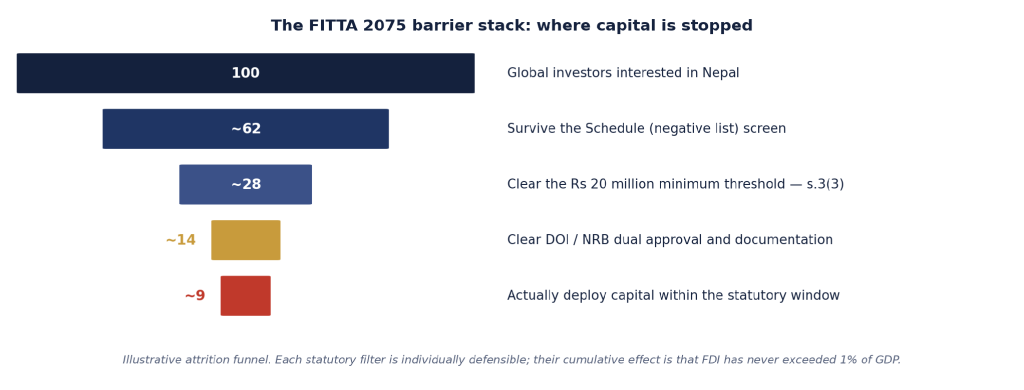
Figure 6. Cumulative attrition of prospective foreign investment under the present regime. Each filter — the Schedule, the minimum threshold, dual approval by the Department of Industry and Nepal Rastra Bank, and the statutory deployment window — is individually defensible on its own terms. The funnel illustrates the compound effect, which is what an investor actually experiences. Proportions are illustrative.
The four heads that most damage the enterprise economy
Head 2 — cottage and small industries (लघु तथा घरेलु उद्यम). This is the single most consequential exclusion in the Schedule for the subject matter of this paper. Nepal’s enterprise base is, as established in Section 2, overwhelmingly composed of micro and small firms. Head 2 closes that entire stratum to foreign equity. The combined effect of Head 2 and the Rs 20 million threshold is a regime in which small firms may not receive small investments and may not receive foreign ones either.
Head 1 — primary agriculture. The head excludes animal husbandry, fisheries, apiculture, horticulture, oilseeds, pulses and dairy, save where at least seventy-five percent of output is exported, and save for agricultural technology and mechanisation. Nepal simultaneously runs a large agricultural trade deficit and forbids foreign capital from addressing it at the primary production stage. The exception for agri-technology is welcome and should be read broadly.
Head 6 — tourism services. Travel agencies, tourist guiding, trekking and mountaineering guiding, and rural tourism including homestay are closed. Nepal’s principal comparative advantage in services is thereby ring-fenced against the capital, distribution systems and international marketing reach that would scale it.
Head 8 and Head 9 — professional and consultancy services. Management, accounting, engineering and legal consultancy, together with language, music and computer training, are closed under Head 8; consultancy with more than fifty-one percent foreign investment is closed under Head 9. These are precisely the knowledge-transfer channels through which technical and managerial capability normally enters a developing economy.
Recommendation 10 — Rewrite the Schedule under Section 50
Section 50 empowers the Government to alter or amend the Schedule by Gazette notification. Primary legislation is not required. We recommend the Schedule be reduced to genuinely strategic exclusions — Head 4 (arms, ammunition, explosives, NBC weapons, atomic energy and radioactive materials) and the security-relevant elements of Head 5 and Head 7 — and that the following be removed or substantially narrowed:
• Head 2 (cottage and small industries) — remove entirely. Replace, if a domestic protection concern persists, with a modest minority-stake cap in defined subsectors.
• Head 1 — retain the technology exception and remove the seventy-five percent export condition, which perversely permits foreign investment only where output leaves the country.
• Head 6 — remove for capital-intensive tourism infrastructure; retain guiding licences for Nepali nationals, which is a labour-market rather than a capital question and should be regulated as such.
• Head 8 and 9 — permit foreign majority participation where the entity commits to a verifiable knowledge-transfer and local-training obligation.
6.3 What the Act already gets right
Balance requires acknowledging the Act’s genuine strengths, several of which are underused rather than deficient:
| Provision | What it provides | Why it matters / why it is underused |
| s.13(1) | No maximum ceiling on foreign investment amount or shareholding | Nepal is more liberal than commonly assumed on the upside; the binding constraint is the floor, not the ceiling |
| s.32 | National treatment — foreign investment to be treated no less favourably than domestic | A strong investor protection, subject to enumerated carve-outs at s.32(4) |
| s.33 | No nationalisation; expropriation only for public purpose with due process | Directly addresses the sovereign risk concern that deters emerging-market investors |
| s.34 | Grandfathering — adverse changes to incentives do not apply to existing investors without consent | Functionally a stability clause; should be publicised far more actively |
| s.42 | Automatic route may be prescribed for company registration, industry registration and investment approval | The enabling power for genuine single-window automation already exists and is largely unused |
| s.45 | Contract and sub-contract manufacturing expressly permitted between industries of similar objective | Discussed at Section 9.3 — the legal basis for third-party manufacturing already exists |
| s.7A | Nepali industries may transfer technology abroad and invest the proceeds overseas | An outbound channel of real strategic value to software and engineering firms; almost unknown in practice |
Recommendation 11 — Operationalise the automatic route under Section 42
Prescribe by regulation an automatic approval route covering: all investments by non-resident Nepalis; all investments in information technology and technology-transfer arrangements; and all investments below a defined value in any sector not on the revised Schedule. Approval should be deemed granted where the Department of Industry has not responded within the seven-day period which Section 15(2) already specifies. A statutory deadline without a deemed-approval consequence is a target, not an obligation.
6.4 The compounding restriction at Section 12(5)
An interaction effect deserves specific attention. Section 12 permits industries to raise project finance from foreign financial institutions. Section 12(5) then provides that industries listed in the Schedule may not do so. The consequence is that a cottage or small industry — already barred from foreign equity by Head 2 — is additionally barred from foreign project debt. Such an enterprise is confined entirely to a domestic banking system that lends against land. Sections 3 and 12 thus close, in combination, every external financing channel available to precisely the enterprise class that most needs one.
Recommendation 12 — Decouple the debt restriction from the equity restriction
Amend Section 12(5) so that the Schedule governs equity participation only. Foreign project debt, technology transfer and lease financing raise no ownership-control concern and should be available to any lawfully registered Nepali enterprise, whatever its sector.
Section Seven
Non-Resident Nepalis: The Constitutional and Economic Case
Approximately 2.2 million Nepalis were living abroad at the 2021 census. They remit more than a quarter of national GDP. In the foreign investment regime, they are classified as foreign investors.
FITTA 2075 — Section 2(ट) · Definition of foreign investor
(ट) “विदेशी लगानीकर्ता” भन्नाले विदेशी लगानी गर्ने विदेशी व्यक्ति, फर्म, कम्पनी, गैर आवासीय नेपाली वा विदेशी सरकार वा अन्तर्राष्ट्रिय संस्था वा अन्य यस्तै प्रकारका सङ्गठित संस्थालाई सम्झनुपर्छ…
“‘Foreign investor’ means a foreign person, firm, company, non-resident Nepali, foreign government, international organisation or other similarly organised institution making foreign investment.” The non-resident Nepali is placed, definitionally, in the same category as a foreign government.
7.1 The partial concession already in the Act
The statute is not wholly indifferent to this. The proviso to Section 15(1) provides that where a non-resident Nepali, or a company, firm or investment fund in which non-resident Nepalis hold more than fifty percent of shares, makes an investment under sections 7 or 8 of the Non-Resident Nepali Act 2064, the investor need only inform the Department, which shall thereupon grant approval. Section 3(3), as discussed, separately permits a different minimum threshold for NRNs. Nepal therefore possesses two distinct statutory hooks on which a genuine diaspora investment class could be hung. Neither has been developed into an operative regime.
7.2 The constitutional dimension
We advance this argument with appropriate caution, as a policy submission rather than a legal opinion. The Constitution of Nepal recognises non-resident Nepali citizenship, and Article 17 guarantees, to every citizen, the freedom to practise any profession, carry on any occupation, and establish and operate any industry, trade or business. Where a person holding non-resident Nepali status is required to satisfy an investment threshold that no resident citizen must satisfy, in order to place capital in a Nepali enterprise, a serious question arises as to whether the restriction is a proportionate limitation on that freedom. At minimum, the differential treatment demands a public justification that has not, to our knowledge, been articulated.
Rs 1.72 trillion
Remittance received in FY 2024/25 — a nineteen percent year-on-year increase. Nepal accepts this capital without condition when it arrives as wages to be consumed, and restricts it when the same people attempt to send it as equity to be invested.
Recommendation 13 — Create a distinct NRN investment class
By Gazette notification under Section 3(3) and accompanying NRB circular, establish a non-resident Nepali investment category with: (a) no minimum investment threshold; (b) automatic-route approval with deemed consent after seven days; (c) a standing, pre-approved repatriation entitlement for principal and returns, subject only to tax clearance; (d) eligibility to subscribe directly to units of registered venture capital and specialised investment funds under sections 9 and 9A; and (e) a single digital window operated by the proposed National SME & Startup Authority, with identity verification against the NRN identity card.
Recommendation 14 — Issue a sovereign Diaspora Bond and open the secondary market
Consistent with our March 2026 Roadmap, we recommend an annual NPR 100 billion diaspora bond programme, denominated in convertible currency, with proceeds ring-fenced for export-oriented industrial infrastructure and reported against publicly disclosed milestones. Separately, non-resident Nepalis and NRN-majority institutional funds should be permitted to invest in the domestic securities market with a simple one-year lock-in, using the framework Section 10 already establishes for secondary-market participation.
Recommendation 15 — Establish a Brain Gain and Knowledge Transfer Centre
Capital is the less scarce of the two things the diaspora holds. Nepal should systematically map the expertise of highly skilled non-resident Nepalis — in semiconductors, clinical medicine, machine learning, structural engineering, regulatory affairs — and create formal, compensated channels through which that expertise enters domestic policy formation, university curricula and enterprise advisory boards. Section 7A of FITTA, permitting Nepali entities to transfer technology abroad and open overseas branches, provides an underappreciated legal basis for two-way institutional links.
Section Eight
Innovation, Incubation and the University–Industry Interface
Nepal has no functioning national incubation network, no systematic university–industry technology transfer, and no published map of the skills its education system produces against the skills its economy requires. The country trains people for an economy that exists elsewhere, and then observes that they have gone there.
8.1 The three missing links
Incubation. Isolated incubators operate, largely donor-funded and concentrated in Kathmandu. What does not exist is a national network with common standards, sustained public co-funding, and a defined pipeline into the concessional credit and guarantee instruments described in Section 5. An incubator that cannot connect a graduating venture to capital is a training programme, not an incubator.
Technology transfer. Nepali universities do not operate technology transfer offices capable of assessing, protecting and licensing intellectual property generated by their own faculty and students. Consequently, publicly funded research does not convert into commercial activity, and industry has no institutional counterparty when it seeks research capability.
Labour market intelligence. No annual, granular mapping exists of graduate output by discipline against employer demand by occupation. Curriculum planning, scholarship allocation and technical education investment therefore proceed substantially blind.
Recommendation 16 — Fund provincial innovation and technology transfer offices
Establish, within the leading university of each province, an Innovation and Technology Transfer Office funded on a matching basis — public capital matched by private sector and industry contribution. Each office should hold a mandate covering incubation, IP assessment and filing support, industry-sponsored research brokerage, and student venture formation. Performance should be measured on ventures formed, IP filed, licensing income and industry-funded research volume, published annually.
Recommendation 17 — Mandate an annual National Skills and Jobs Map
The National Statistics Office, working with the Ministry of Education, Science and Technology and the proposed Authority, should publish an annual open-data map of graduate output by discipline and level against vacancy and employment data by occupation and province. Public technical education investment should be formally required to reference it. What is not measured cannot be planned.
Recommendation 18 — Mandatory apprenticeship under a “Degree Plus” framework
Require a structured, credit-bearing internship or apprenticeship component in all tertiary programmes, with a tax credit to employers offering placements. The dual objective is that students earn while they learn, and that employers acquire a low-risk recruitment pipeline. This measure was proposed in our March 2026 Roadmap and we restate it here in the enterprise context: SMEs, which cannot compete on starting salary, benefit disproportionately from structured early-career pipelines.
Section Nine
Tariff Inversion and the Contract Manufacturing Opportunity
In a material number of tariff lines, the customs duty payable on an imported raw material exceeds the duty payable on the equivalent imported finished product. Where that condition holds, domestic manufacturing is not merely unsupported — it is actively taxed relative to importing.
9.1 The mechanism
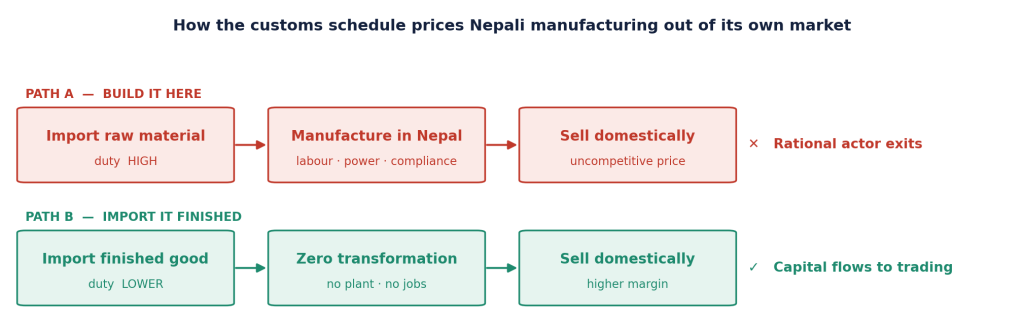
Figure 7. The decision faced by a rational Nepali investor under an inverted duty structure. Path A absorbs the higher input duty and additionally bears conversion cost, power tariff, labour compliance and certification burden. Path B avoids all of it. The structure does not merely fail to encourage manufacturing; it prices manufacturing above importing and then relies on entrepreneurs behaving irrationally.
Duty inversion arises in most tariff schedules through accretion rather than design: individual rates are adjusted over successive Finance Acts in response to particular representations, and the cumulative relationship between input and output lines is never systematically reviewed. The correction is therefore technical rather than ideological, and it is inexpensive — the fiscal cost of lowering input duties is partially offset by the revenue from increased domestic production and by reduced finished-goods imports.
Recommendation 19 — Conduct and publish a full customs inversion audit
The Department of Customs, with the Inland Revenue Department and the proposed Authority, should conduct a line-by-line review of the customs tariff identifying every instance in which the effective duty on an input exceeds that on the corresponding finished good. The audit should be published. Every identified inversion should be corrected in the next Finance Act, with a standing instruction that future tariff amendments be accompanied by an inversion impact statement. This is the single highest-return, lowest-cost measure in this paper.
9.2 Effective rate of protection
We recommend the audit be framed not around nominal duty rates but around the effective rate of protection, which measures protection afforded to the value-added activity itself rather than to the finished output. Where the effective rate of protection for a domestic manufacturing activity is negative, the tariff structure is transferring income from domestic producers to importers. Reporting effective rates by sector would make visible a distortion that nominal rates conceal.
9.3 Contract manufacturing: the law already permits it
Third-party and contract manufacturing was the mechanism through which East Asian economies — most conspicuously China, and before it Taiwan and South Korea — built industrial capability. Small firms manufacture to the specification of larger domestic or foreign brands, acquiring process discipline, quality systems and scale without carrying brand or distribution risk. It is the fastest known route from artisanal production to industrial capability.
It is commonly asserted that Nepali law obstructs this. That assertion requires qualification. Section 45 of FITTA expressly provides for it:
FITTA 2075 — Section 45 · Contract manufacturing
४५. करार गरी उत्पादन गर्न सकिने: (१) विदेशी लगानी भएको उद्योगले समान उद्देश्य भएको अन्य उद्योगसँग एकआपसमा करार (कन्ट्र्याक्ट) वा उपकरार (सब-कन्ट्र्याक्ट) गरी वस्तु वा सेवाको उत्पादन गर्न वा गराउन सक्नेछ।
“An industry with foreign investment may, by entering into a contract or sub-contract with another industry having a similar objective, produce or cause to be produced goods or services.” The enabling provision exists. The constraints are the qualifier “similar objective,” the absence of implementing regulation under sub-section (2), and — critically — excise, VAT and traceability rules that make the movement of work-in-progress between two registered entities administratively punishing.
Recommendation 20 — Issue contract manufacturing regulations
Frame regulations under Section 45(2) that: (a) broaden “similar objective” to any lawfully registered manufacturing activity; (b) establish a job-work regime under which inputs may move between principal and contract manufacturer without triggering a taxable supply, with VAT and excise accounted for on final clearance; (c) provide a simple traceability and record-keeping standard proportionate to enterprise size; and (d) extend the regime to purely domestic arrangements, not only to industries with foreign investment. Nepal’s small manufacturers cannot build brands and distribution simultaneously; contract manufacturing lets them build capability first.
Section Ten
Energy Pricing for Industry
Nepal generates surplus hydroelectricity in the wet season and prices it to domestic industry at rates that leave Nepali manufacturers uncompetitive against regional peers. Surplus energy that is exported cheaply, or spilled, while domestic industry is priced out, is a policy failure with an unusually clear remedy.
Recommendation 21 — Introduce a dedicated industrial and startup tariff
The Nepal Electricity Authority, with the Electricity Regulatory Commission, should establish a distinct industrial tariff category with: (a) time-of-use pricing that passes genuine off-peak and wet-season surplus economics through to industrial consumers; (b) a dedicated low tariff band for enterprises in Net Value Contribution Bands A and B under Recommendation 3; (c) a “power-for-jobs” schedule under which tariff relief is graduated against verified employment and output rather than granted as a flat subsidy; and (d) guaranteed dedicated feeders for registered industrial estates and special economic zones. Any subsidy element must be routed through the banking system and disclosed, in accordance with Recommendation 29.
Section Eleven
Intellectual Property, Standards and Certification
An idea that cannot be legally owned cannot be financed, licensed, franchised or defended. A product that cannot be certified cannot be exported. Nepal’s enterprise sector is constrained on both counts.
11.1 The present position
Intellectual property administration in Nepal remains a function of the Department of Industry, operating substantially under the Patent, Design and Trade Mark Act 2022 (1965) — a statute older than most of the technologies it is now asked to govern. Filing is largely paper-based; examination capacity is limited; and there is no statutory determination deadline against which an applicant may plan. For a startup, the practical consequence is that intellectual property cannot be treated as a financeable asset, which in turn removes the principal non-land security a knowledge-based firm could offer a lender.
On standards, Nepal’s testing and certification infrastructure lacks broad international mutual-recognition accreditation. The result is that a Nepali producer must frequently re-test abroad at the buyer’s insistence, adding cost and delay that small exporters cannot absorb.
Recommendation 22 — Establish an autonomous Nepal Intellectual Property Office
Constitute the IP function as an autonomous statutory office with its own budget, technically qualified examiners, and end-to-end digital filing. Enact statutory examination and determination timelines with published performance reporting. Modernise the underlying substantive law, including express provision for software, designs, trade secrets and plant varieties. Accede, where terms permit, to international filing arrangements so that a Nepali applicant may seek protection in export markets from a domestic filing.
Recommendation 23 — Accredit testing laboratories to mutual-recognition standards
Fund accreditation of Nepali testing, calibration and certification laboratories to international standards, prioritising the sectors in which Nepal has demonstrated export capability: agro-processing, tea and coffee, herbal and essential oils, handicrafts, textiles, and processed foods. The objective is that a certificate issued in Kathmandu is accepted in Frankfurt, Seoul or Dubai without re-testing. The tea sector experience of 2026 demonstrates the cost of the alternative.
Recommendation 24 — Recognise registered IP as admissible loan security
Amend the secured transactions framework and NRB directives so that registered patents, trademarks, industrial designs and licensing revenue streams may be pledged, registered in the Secured Transactions Registry, and recognised for provisioning purposes. Without this, Recommendation 22 improves legal protection without improving access to capital.
Section Twelve
Credit Discipline: The Case for a Prompt Payment Act
Nepal has no statutory framework governing commercial payment terms. A small supplier that delivers to a large buyer waits to be paid at the buyer’s convenience, with no remedy faster than its own insolvency. Nepali enterprises predominantly fail from cash-flow strangulation, not from absence of demand.
12.1 The asymmetry
The bargaining position between a thirty-person component manufacturer and its principal corporate customer is not equal, and contract law assumes that it is. The supplier cannot credibly threaten litigation, because litigation is slower than its cash runway, and cannot credibly threaten to withdraw supply, because the customer represents a large share of its order book. The result is a systematic, uncompensated transfer of working capital from the smallest firms in the economy to the largest — which is to say, from the firms least able to finance it to those best able. Government agencies and state-owned enterprises are, on the evidence of contractor arrears, significant participants in this transfer.
Statutory interest is the mechanism.
The purpose of a prompt payment regime is not to generate litigation. It is to make delay more expensive than payment, so that the commercial incentive corrects itself and the courts are never engaged.
Recommendation 25 — Enact a Prompt Payment and Commercial Credit Act
We propose primary legislation containing the following elements, drawn from the UK Late Payment of Commercial Debts legislation, the EU Late Payment Directive, and India’s MSMED Act provisions on delayed payment to micro and small enterprises:
• Statutory maximum terms. Payment due within 45 days of acceptance of goods or services where the buyer is a large enterprise or public body, and within 30 days where no term is expressly agreed. Contractual terms exceeding the maximum to be void as against a registered micro or small supplier.
• Automatic statutory interest. Interest accruing without demand at a rate materially above the policy rate, plus a fixed recovery cost, non-waivable by contract.
• Public sector binding. The Act to apply to all federal, provincial and local government bodies and state-owned enterprises without exception, with accounting officers personally answerable for arrears reporting.
• Fast-track adjudication. A summary determination process seated within the proposed Authority, with awards enforceable as decrees, and a determination deadline of 90 days.
• Mandatory payment practice disclosure. Enterprises above a turnover threshold to publish, semi-annually, average payment days and the proportion of invoices paid beyond terms. Disclosure has proved the most effective single element of comparable regimes.
Recommendation 26 — Build a receivables discounting platform
Once a legal entitlement to timely payment exists, a receivable becomes a financeable asset. Establish a regulated electronic invoice discounting platform — comparable in function to India’s TReDS — on which registered small suppliers may auction verified receivables to licensed financiers. This converts the reform from a defensive measure into a working-capital instrument, and requires no public subsidy once the legal foundation and the platform exist.
Section Thirteen
Export Promotion and Market Access
Nepal possesses no serious export promotion machinery: no trade intelligence service, no state-supported digital export channel, and no standing capacity to respond when a trading partner changes a rule.
13.1 A case study in institutional absence
The orthodox tea sector, 2026
Following the Tea Board of India’s enforcement of mandatory laboratory testing requirements for tea imports from May 2026, testing delays and warehouse backlogs prevented sales and payments to Nepali growers. Reports in mid-2026 indicated that 86 factories in Ilam and Jhapa announced indefinite shutdown, with industry representatives stating that the Nepali government had failed to resolve the matter diplomatically. Those factories did not close because their tea was deficient. They closed because a single regulatory change in a single market was not met by any institution with the mandate, expertise or standing to respond within the commercially relevant window.
13.2 The LDC graduation overlay
Nepal’s scheduled graduation from Least Developed Country status removes a range of preferential market access arrangements on which existing export flows depend. Our March 2026 Roadmap estimated the immediate exposure and recommended pursuing access to the European Union’s GSP+ scheme together with negotiated transition periods. We restate that recommendation here, because graduation and the reforms in this paper interact: an enterprise sector without certification infrastructure, trade intelligence or barrier response capacity will absorb the graduation shock considerably less well than one possessing them.
Recommendation 27 — Establish a Nepal Export Promotion Agency
Constitute a properly funded agency with: commercial attachés posted in priority markets and formally appraised on export value facilitated rather than on representational activity; a trade intelligence unit publishing market access conditions, tariff schedules and standards requirements by product and destination; a standing trade barrier response unit with a defined escalation protocol to the Ministry of Foreign Affairs and a published response-time commitment; and export readiness support covering certification, packaging, labelling and compliance for first-time exporters.
Recommendation 28 — Launch a national digital export storefront
Operate a state-backed digital platform through which certified Nepali producers can reach international buyers, with integrated payment settlement, logistics aggregation and verified certification display. The binding constraint for a Nepali producer is not manufacturing capability but customer acquisition cost in a foreign market. Aggregation is the standard remedy, and it is a public good that no individual small producer can build.
Section Fourteen
Technology Sovereignty: Compute, AI and the Knowledge Economy
The Sovereign AI Compute Centre announced in the FY 2083/84 budget is, in our assessment, the most consequential forward-looking commitment in that document. Whether it becomes a capability or a building depends entirely on decisions not yet taken.
14.1 From facility to capability
A compute facility delivers national capability only if three conditions hold: sufficient accelerator hardware to run non-trivial workloads; an allocation mechanism that reaches researchers and founders rather than only large institutions; and a pricing structure that an early-stage venture can afford. Absent these, a sovereign compute centre becomes a procurement achievement rather than an economic one.
Recommendation 29 — Procure GPU capacity at scale and allocate it competitively
Commit to a multi-year accelerator procurement schedule with published capacity targets. Reserve a defined proportion — we suggest not less than thirty percent — of total capacity for open competitive allocation to startups, university research groups and individual researchers, awarded by merit-based peer review on a rolling basis, at subsidised or zero cost. Publish allocation decisions. A nation that rents its computational capability indefinitely will remain a consumer of the digital economy rather than a producer within it.
Recommendation 30 — Extend the IT concession model to adjacent technology sectors
The budget’s fifty percent income tax exemption on IT service exports establishes a principle: Nepal will tax knowledge-intensive export activity concessionally because the externalities — skills, retention, foreign exchange — exceed the foregone revenue. That principle applies with equal force to biotechnology, precision engineering, advanced manufacturing, engineering services, clinical research and digital health. We recommend the concession be defined by activity characteristics rather than by sector label, so that it does not require a new legislative act each time a new industry emerges.
We further note, and support, the budget’s provision of a legal framework permitting Nepali citizens to work remotely from Nepal for foreign employers. This is a materially important talent-retention instrument: it allows a Nepali engineer to earn an international wage without emigrating, keeping both the person and a portion of their spending inside the economy. Its value will be determined by the tax treatment and the ease of receiving international payments — which brings us to a persistent operational barrier.
Recommendation 31 — Remove international payment gateway barriers
Nepali freelancers, IT firms and digital exporters remain constrained in receiving international payments through mainstream gateways. Nepal Rastra Bank should establish a clear, published regulatory pathway for international payment service providers to operate for inbound service-export receipts, with proportionate anti-money-laundering controls. A knowledge economy that cannot receive payment is not a knowledge economy.
Section Fifteen
Taxation: Widening the Base, Rebalancing the Burden
Approximately half of Nepal’s economic activity is taxed. The other half is not. Each year the compliant half is asked to carry more, and each year the calculation that compliance is a losing strategy becomes marginally more persuasive.
15.1 Base before rate
The instinct to raise rates on registered taxpayers is administratively convenient and economically corrosive. It taxes formality itself, and thereby subsidises informality. The alternative — bringing the untaxed into the system — is harder in the first instance and substantially better thereafter, because it permits lower rates for everyone and removes the competitive disadvantage currently borne by compliant firms.
The instruments required for this exist and are, encouragingly, already under construction. The FY 2083/84 budget commits to an integrated national identity database, a “one-time information for all services” principle, and digitised business registration and tax administration. Third-party data matching across bank transactions, land and vehicle registries, utility connections, customs declarations and tax filings is a well-established technique for identifying unregistered economic activity. We recommend it be pursued systematically and that the resulting revenue be explicitly and publicly hypothecated to rate reduction, so that compliant taxpayers see a direct return from enforcement.
15.2 Structural composition of revenue
Beyond the base lies the composition question set out at Figure 5. Nepal’s revenue model depends heavily on customs duty and on consumption financed by remittance. Both are structurally fragile. Customs revenue creates a fiscal interest in continued import dependence — the state earns more when Nepal makes less. Remittance-funded consumption depends on the continued willingness of destination countries to absorb Nepali labour, a variable entirely outside national control.
Recommendation 32 — A four-part taxation reform package
• R&D super-deduction. Permit enterprises to deduct 150 to 200 percent of qualifying research and development expenditure against taxable income, with a defined qualifying-expenditure schedule and, for pre-profit startups, a refundable credit alternative.
• Activity-based concessional corporate rate. Extend concessional rates beyond IT to all high-value, knowledge-intensive and export-earning activity, defined by characteristics rather than sector label, and tiered to the Net Value Contribution band.
• Startup tax holiday. Full income tax exemption for the first five years of operation for qualifying startups below a defined turnover ceiling, as proposed in our March 2026 Roadmap, conditional on continued compliance and employment reporting.
• Banking-channel discipline for all subsidies. Every government subsidy, concession, grant and incentive to enterprise to be disbursed exclusively through the banking system against a registered account, with beneficiary-level disclosure published quarterly in machine-readable form. Transparency is not an accounting preference; it is the only anti-corruption mechanism that scales without adding administrative headcount.
Section Sixteen
Meritocracy and HDI-Based Inclusion
We advance two propositions in this section, in the awareness that the second is contested and that reasonable people hold opposing views on it in good faith.
First, meritocracy in state function. Appointment to public office, allocation of public procurement, selection for concessional credit and admission to state-supported programmes should be governed by transparent, published, contestable criteria applied without regard to political affiliation. This proposition is, we think, uncontroversial in principle and unevenly observed in practice. Its relevance to enterprise policy is direct: a concessional credit programme allocated on connection rather than merit does not merely waste money, it teaches an entire generation of founders that commercial quality is not the operative variable.
Second, the basis of inclusion. We submit that targeting of state support is more effective and more just when calibrated to measured deprivation — access to finance, education, health services, connectivity and infrastructure, as captured in Human Development Index-type indicators — than when calibrated to identity category. Our reasoning is that identity operates as a proxy for deprivation, and that a proxy necessarily mis-targets in both directions: it reaches non-deprived members of a designated group and misses deprived members of a non-designated one.
The counter-argument, stated fairly
We record the principal objection to this position, which is serious. Where discrimination is historic, structural and ongoing, deprivation indices may under-capture the specific barriers that a particular community faces — access to networks, credit officers’ implicit assumptions, supply chain exclusion — because those barriers are not fully expressed in income, schooling or health statistics. On this view, identity-conscious measures address a mechanism that a deprivation index cannot see. We do not think this objection is answered by assertion. We propose instead that it be settled empirically: that Nepal collect and publish disaggregated data on enterprise credit approval rates, procurement award rates and programme participation by both deprivation quintile and social group, and that targeting methodology be revised in light of what the data shows. If identity-based barriers persist after controlling for deprivation, that is a finding which should change policy.
Section Seventeen
The Demographic Constraint
The quantitative position was set out at Section 2.4 and Figure 4. Here we state its policy consequence directly.
Every recommendation in this paper is an investment whose return is realised through people: founders who start firms, workers who staff them, engineers who improve them. The supply of those people is contracting on two margins simultaneously. Births have fallen below replacement. Departures continue at scale, and they are selective — those who leave are disproportionately young, disproportionately skilled, and disproportionately the individuals who would otherwise have founded or staffed the enterprises this paper is designed to enable.
The asymmetry of delay
Reform delayed is not reform deferred at constant value. A migration decision, once executed, is substantially irreversible: a family relocates, children enter foreign school systems, professional networks form abroad. Nepal is not choosing between reforming now and reforming later. It is choosing between reforming now for the cohort that is currently deciding whether to stay, and reforming later for a cohort that will be smaller, older, and selected for having had fewer options.
We therefore urge that the ninety-day executive package set out in Section 1 be treated as genuinely urgent. Those four measures require no legislation, no appropriation and no institutional construction. They can be executed by notification and directive. Their principal cost is the political effort of deciding to do them.
Section Eighteen
Implementation Sequence and Performance Framework
Reform agendas fail more often in sequencing than in design. This section orders our thirty-two recommendations by the instrument each requires, so that measures needing only executive action are not held hostage to those needing legislation.
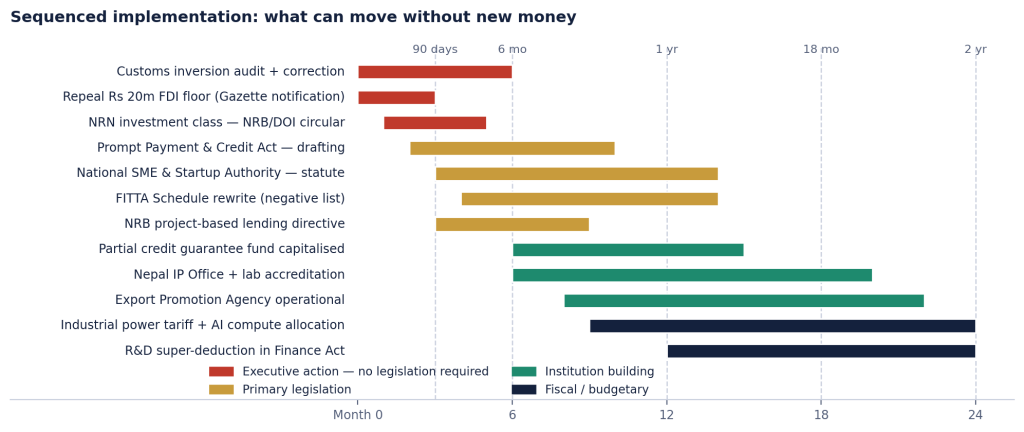
Figure 8. Sequenced implementation over twenty-four months, colour-coded by the instrument required. Red items require no new legislation and no new appropriation — they proceed by Gazette notification, ministerial directive or administrative order. The design principle is that the reform programme should produce visible results within ninety days, because credibility earned early finances the political capital that later legislation will require.
18.1 Sequencing by instrument
| Horizon | Instrument | Measures |
| 0–90 days | Gazette notification / directive | Repeal Rs 20m FDI floor (R9); NRN investment circular (R13); commission customs inversion audit (R19); banking-channel subsidy instruction (R32.4); publish startup definition consolidation (R2) |
| 3–6 months | Regulation / NRB circular | Project-based lending directive (R5); automatic route under s.42 (R11); contract manufacturing regulations (R20); international payment gateway pathway (R31); industrial power tariff order (R21) |
| 6–12 months | Primary legislation | National SME & Startup Authority Act (R1); Prompt Payment and Commercial Credit Act (R25); FITTA Schedule rewrite and s.12(5) amendment (R10, R12); IP Office statute (R22) |
| 6–18 months | Institution building | Credit guarantee facility capitalisation (R6); provincial innovation offices (R16); laboratory accreditation (R23); Export Promotion Agency (R27); receivables platform (R26); digital export storefront (R28) |
| 12–24 months | Finance Act / budget | Customs inversion correction (R19); R&D super-deduction and concessional rates (R32); GPU procurement and allocation (R29); diaspora bond issuance (R14); Degree Plus apprenticeship credit (R18) |
18.2 The performance framework
We propose that the Government commit to being measured against a small number of outcome indicators, published quarterly and independently verified, rather than against input measures such as budget size or projects inaugurated. The distinction matters: input measures reward spending, outcome measures reward results.
| Indicator | Baseline (2026) | Target (2031) | Source / verification |
| Formal jobs created within Nepal, annual | To be established | 500,000 per year | NSO Labour Force Survey; SSF registrations |
| Enterprise 3-year survival rate | Not currently measured | Measured and rising | Proposed Authority registry linked to IRD filings |
| Goods and services exports, share of GDP | Approx. 7% | Materially higher; export–import ratio to 20:80 | NRB balance of payments |
| FDI as share of GDP | <1% | 3%+ | NRB; Department of Industry approvals versus realisation |
| Enterprise credit on non-land security | Not disclosed | Disclosed and rising | Mandatory NRB institutional disclosure (R5) |
| Average public-sector payment days | Not measured | Under 45 days | Mandatory disclosure under proposed Act (R25) |
| Net migration of working-age citizens | Strongly negative | Trend reversal | Department of Foreign Employment; NSO |
| Registered IP filings by domestic entities | Very low | Order-of-magnitude increase | Proposed Nepal IP Office |
A closing proposition.
The government’s role is not to run enterprises. It is to write fair rules, hold the ring, and let capability compete. Nepal has already proved it can do this: the payments and fintech ecosystem — QR acceptance from a Thamel bookshop to a Jumla teashop — grew because the state regulated sensibly and then made room. The recommendations in this paper ask for nothing more exotic than that the same posture be extended to the rest of the enterprise economy.
Annex A
FITTA 2075 Schedule — The Full Negative List
Reproduced below in full is the Schedule to the Foreign Investment and Technology Transfer Act 2075 (2019), referred to in Section 3(2), listing industries and businesses in which foreign investment is not permitted. The Schedule has been amended by Gazette notification dated 2077/09/20, by the Act Amending Certain Nepal Acts Relating to Investment Facilitation 2081, and by the Act Amending Certain Nepal Acts Relating to Improvement of the Economic and Business Environment and Investment Enhancement 2081.
Statutory basis · FITTA 2075, Sections 3(1), 3(2) and 50
३. विदेशी लगानी गर्न सक्ने: (१) विदेशी लगानीकर्ताले अनुसूचीमा उल्लिखित उद्योग बाहेक अन्य जुनसुकै उद्योगमा विदेशी लगानी गर्न र त्यस्तो लगानीबाट लाभ प्राप्त गर्न सक्नेछ।
५०. अनुसूचीमा हेरफेर वा थपघट गर्न सक्ने: नेपाल सरकारले नेपाल राजपत्रमा सूचना प्रकाशन गरी अनुसूचीमा आवश्यक हेरफेर वा थपघट गर्न सक्नेछ।
Section 3(1) permits foreign investment in any industry other than those listed in the Schedule. Section 50 permits the Government of Nepal to alter, add to or remove items from the Schedule by notification in the Nepal Gazette. Amendment of the negative list therefore requires no Act of Parliament — a point of central importance to Recommendation 10.
| # | Industry or business closed to foreign investment | Catalyst Club assessment |
| 1 | Any industry or business (excluding agricultural technology and mechanisation) related to animal husbandry, fish farming, beekeeping, fruits, vegetables, oilseeds, pulses, dairy business, and primary agricultural production — that produce and export at least seventy-five percent of their output | Amend Retain the technology and mechanisation exception; remove the 75 percent export condition, which permits foreign capital only where output leaves Nepal |
| 2 | Cottage and small industries | Remove The single most damaging head for the enterprise economy; closes 99% of Nepali firms to foreign equity |
| 3 | Personal service business (hair cutting, tailoring, driving etc.) | Retain Low economic cost; a defensible livelihood protection |
| 4 | Industries manufacturing arms, ammunition, bullets and shell, gunpowder or explosives, and nuclear, biological and chemical (N.B.C.) weapons; industries producing atomic energy and radio-active materials | Retain Core national security exclusion; standard in comparable jurisdictions |
| 5 | Real estate business (excluding construction industries), retail business, internal courier service, local catering service, moneychanger, remittance service | Narrow Retain for real estate speculation, moneychanging and remittance; review retail and courier, where scale capital and logistics technology would raise productivity |
| 6 | Travel agency, guide involved in tourism, trekking and mountaineering guide, rural tourism including homestay | Amend Regulate guiding as a labour-market licensing question; open capital-intensive tourism infrastructure to investment |
| 7 | Business of mass communication media (newspaper, radio, television and online news) and motion picture of national language | Retain Information sovereignty; standard in most jurisdictions |
| 8 | Management, account, engineering, legal consultancy service and language training, music training, and computer training | Amend These are the principal channels of knowledge transfer into a developing economy; permit subject to local training obligations |
| 9 | Consultancy services having foreign investment of more than fifty-one percent | Amend Raise the cap where verifiable technology and skills transfer commitments are undertaken |
| 10 | Ride sharing exceeding seventy percent of foreign investment | Review A 70% cap is comparatively liberal; retain but monitor against platform competition outcomes |
| 11 | In case of aircraft operation, training, repair and maintenance and passenger service facility provider, foreign investment exceeding the following limits: A. International airlines service — eighty percent B. Domestic airlines service — forty-nine percent C. Training institution — ninety-five percent D. Repair and maintenance — ninety-five percent | Retain Sectoral caps rather than prohibitions; broadly consistent with international aviation practice |
Summary of the Annex A recommendation
Of eleven heads, we propose that four be retained substantially unchanged (3, 4, 7, 11), two be narrowed (5, 10), and five be materially amended or removed (1, 2, 6, 8, 9). The resulting Schedule would remain a genuine negative list protecting security, information sovereignty and identified livelihood interests — while ceasing to exclude foreign capital and technology from agriculture, small industry, tourism services and professional knowledge transfer, which together represent the greater part of Nepal’s realistic comparative advantage.
Annex B
Key Statutory Provisions Relied Upon
The following provisions of the Foreign Investment and Technology Transfer Act 2075 (2019) are those on which the analysis in Sections 5, 6, 7 and 9 principally rests. Nepali text is taken from the consolidated version published by the Nepal Law Commission; English renderings are the authors’ working translations and are provided for convenience only.
| Provision | Effect | Relevance to this paper |
| s.2(ट) | Defines “foreign investor” to include non-resident Nepalis alongside foreign persons, firms, governments and international organisations | The definitional root of the NRN problem addressed in Section 7 |
| s.3(1) | Foreign investment permitted in any industry other than those in the Schedule | Establishes the negative-list architecture; see Annex A |
| s.3(3) | Government may prescribe a minimum investment amount by Gazette notification, and may prescribe different limits for NRNs and other foreign investors | The threshold is executive, not legislative — Recommendations 9 and 13 require no Act of Parliament |
| s.7A | Nepali industries may transfer technology abroad, receive foreign currency for it, and invest overseas; may open foreign branch offices with Department approval | An underused outbound channel of strategic value to software and engineering firms (Section 7.2) |
| s.9, s.9A | Venture capital funds and specialised investment funds; foreign investors may purchase units of such funds with SEBON approval | The legal scaffolding for the VC/PE ecosystem sought in Recommendation 7 already exists |
| s.12(1), (4) | Industries may contract project loans and project financing with foreign financial institutions with NRB approval, and may mortgage immovable property to them | Project financing is lawful in Nepal; the deficiency is domestic banking practice (Section 5.1) |
| s.12(5) | Industries listed in the Schedule may not obtain such loans | The compounding restriction identified at Section 6.4 and addressed by Recommendation 12 |
| s.13(1) | No maximum limit on the amount or share of foreign investment | Nepal restricts entry, not scale — the binding constraint is the floor |
| s.15(1) proviso | NRN investment under ss.7–8 of the Non-Resident Nepali Act 2064 requires only notification to the Department, which shall then grant approval | A partial concession already in force; Recommendation 13 builds on it |
| s.15(2) | Approval to be granted within seven days where documentation is complete | A statutory deadline without deemed-approval consequence; Recommendation 11 |
| s.16 | Investor must declare lawful source of funds to NRB; funds to enter through the banking system in convertible currency (Indian rupees permitted for Indian investors) | Demonstrates that AML concerns are addressed by disclosure, not by the minimum threshold |
| s.20 | Repatriation of share sale proceeds, dividends, liquidation surplus, royalty, lease rent and legal awards, in the currency of investment or another convertible currency | Exit rights are legally sound; the practical constraint is process, not entitlement |
| s.23 | One-stop service centre to deliver registration, investment approval, company administration, labour approval, visa, quality certification, environmental approval, energy coordination, PAN and foreign exchange approval | The single-window mandate exists in statute; Section 6.3 notes it is unrealised in practice |
| s.32 | National treatment for foreign investment, subject to enumerated carve-outs at s.32(4) | A material investor protection that Nepal markets insufficiently |
| s.33 | No nationalisation; acquisition only for public purpose following due process | Directly addresses sovereign risk perception |
| s.34 | Changes to conditions or incentives do not apply adversely to previously approved investors without their consent | A functioning stability clause; complements the Economic Development Act stability clause proposed in our March 2026 Roadmap |
| s.42 | Government may provide company registration, industry registration and foreign investment approval through an automatic route by Gazette notification | The enabling power for genuine automation exists and is unused — Recommendation 11 |
| s.45 | An industry with foreign investment may contract or sub-contract production of goods or services with another industry of similar objective | Contract manufacturing is already lawful; the constraint is the absence of regulations under s.45(2) — Recommendation 20 |
| s.50 | Government may amend the Schedule by Gazette notification | Negative list reform requires no parliamentary time — Recommendation 10 |
The central legal finding of this paper
A substantial proportion of what is commonly described as Nepal’s restrictive foreign investment law is not, in fact, contained in the Act. The minimum investment threshold (s.3(3)), the composition of the negative list (s.50), and the availability of an automatic approval route (s.42) are all matters the Government of Nepal may determine by Gazette notification. Parliament has already delegated the power. The reforms most urgently required are therefore executive decisions that have not been taken, rather than legislative changes that cannot be made.
Annex C
Legislative and Executive Instruments Proposed
| Instrument | Type | Core content |
| National SME & Startup Authority Act | Primary legislation | Constitutes the Authority; entrepreneur-majority board with fixed non-renewable terms; registration, classification, credit administration, grievance escalation with binding deadlines; vests the Nepal Enterprise Facility; annual report to Parliament; quarterly machine-readable disclosure |
| Prompt Payment and Commercial Credit Act | Primary legislation | 45-day statutory maximum terms for large and public buyers; 30-day default; automatic non-waivable statutory interest plus recovery cost; binding on all government bodies and state-owned enterprises; 90-day fast-track adjudication with decree-enforceable awards; mandatory payment practice disclosure above a turnover threshold |
| Nepal Intellectual Property Office Act | Primary legislation | Autonomous office with own budget and qualified examiners; digital end-to-end filing; statutory examination and determination deadlines; modernised substantive protection for software, designs, trade secrets and plant varieties; international filing accession |
| FITTA (Amendment) Act | Primary legislation | Amends s.2(ट) to remove NRNs from the definition of foreign investor and create a distinct class; amends s.12(5) so the Schedule governs equity only, not debt or technology transfer; inserts deemed-approval consequence into s.15(2) |
| Gazette notification under s.3(3) | Executive | Reduces the general minimum foreign investment threshold to a nominal figure or removes it; prescribes a separate nil threshold for non-resident Nepalis |
| Gazette notification under s.50 | Executive | Amends the Schedule per Annex A: removes Head 2; amends Heads 1, 6, 8 and 9; narrows Head 5 |
| Gazette notification under s.42 | Executive | Prescribes an automatic approval route for NRN investment, IT and technology transfer, and all sub-threshold investment outside the revised Schedule |
| Foreign Investment (Contract Manufacturing) Regulations under s.45(2) | Regulation | Broadens “similar objective”; establishes a job-work regime deferring VAT and excise to final clearance; proportionate traceability standard; extends the regime to purely domestic arrangements |
| NRB Unified Directive on Enterprise Lending | Regulatory directive | Cash-flow assessment methodology; receivables, purchase orders, registered IP and plant as admissible primary security; differentiated provisioning for guaranteed lending; mandatory quarterly institutional disclosure of non-land-secured enterprise lending share |
| NRB Circular on International Payment Service Providers | Regulatory directive | Published licensing pathway for inbound service-export receipts with proportionate AML controls |
| Finance Act provisions | Annual finance legislation | Correction of every identified duty inversion; R&D super-deduction at 150–200 percent with refundable credit for pre-profit startups; activity-based concessional corporate rate; five-year startup tax holiday below a defined turnover ceiling |
| NEA / ERC Industrial Tariff Order | Regulatory order | Dedicated industrial and startup tariff category; time-of-use pricing reflecting wet-season surplus; power-for-jobs graduation; dedicated feeders for industrial estates and SEZs |
| Council of Ministers instruction on subsidy channelling | Executive | All enterprise subsidies, grants and incentives to be disbursed exclusively through the banking system against registered accounts, with quarterly beneficiary-level publication |
Annex D
References
Primary legislation and official instruments
1. Government of Nepal. Foreign Investment and Technology Transfer Act, 2075 (2019) [विदेशी लगानी तथा प्रविधि हस्तान्तरण ऐन, २०७५]. Consolidated text incorporating amendments by the Act Amending Certain Acts Relating to Prevention of Money Laundering and Promotion of Business Environment 2080; the Act Amending Certain Nepal Acts Relating to Investment Facilitation 2081; and the Act Amending Certain Nepal Acts Relating to Improvement of the Economic and Business Environment and Investment Enhancement 2081. Nepal Law Commission, www.lawcommission.gov.np.
2. Government of Nepal. Schedule to FITTA 2075 (negative list), as amended by Nepal Gazette notification dated 2077/09/20 and by the 2081 amending Acts.
3. Ministry of Industry, Commerce and Supplies. Notice dated 2080/06/15 (2 October 2023) exempting specified information technology industries from the minimum foreign investment threshold.
4. Government of Nepal. Foreign Investment and Technology Transfer Regulations, 2077 (2021).
5. Government of Nepal. Industrial Enterprises Act, 2076 (2020).
6. Government of Nepal. Non-Resident Nepali Act, 2064 (2008), sections 7 and 8.
7. Ministry of Industry, Commerce and Supplies. National Startup Enterprise Policy, 2081; Startup Enterprise Loan Operation Procedure, 2082; and the amended Startup Enterprise Credit Operation Procedures, 2082 introducing the minimum 50-mark evaluation requirement.
8. Ministry of Finance, Government of Nepal. Budget Speech and Appropriation Proposals for Fiscal Year 2083/84, presented to the joint session of the Federal Parliament by Hon. Deputy Prime Minister and Finance Minister Dr. Swarnim Wagle, Jestha 15, 2083 (29 May 2026). Total outlay NPR 2,124.34 billion.
9. Ministry of Finance. Economic Survey, Fiscal Year 2082/83, presented 28 May 2026.
10. Constitution of Nepal, 2072 (2015), Article 17 (right to freedom, including freedom to practise any profession and to establish and operate industry, trade and business) and provisions relating to non-resident Nepali citizenship.
11. Patent, Design and Trade Mark Act, 2022 (1965).
Statistical and institutional sources
12. National Statistics Office (formerly Central Bureau of Statistics), Government of Nepal. National Economic Census 2018 — 923,356 establishments; 95.5% micro, 4.2% small; approximately half formally registered.
13. National Statistics Office. National Population and Housing Census 2021 — population 29.16 million; approximately 2.2 million Nepalis absent abroad.
14. Nepal Rastra Bank. Current Macroeconomic and Financial Situation, monthly and quarterly series; balance of payments and remittance data, FY 2024/25 and FY 2025/26.
15. International Finance Corporation and Government of Nepal. State of the Private Sector in Nepal: Contributions and Constraints (2023) — private sector employment of 4,938,566 persons, equal to 85.6% of the labour force; MSMEs 4,564,040 jobs, SMEs 333,077, large industry 41,449; private sector contribution of 81.55% of GDP.
16. UN Economic and Social Commission for Asia and the Pacific. Study on MSME finance in Nepal — estimated financing gap of US$3.56 billion; SME employment approximately 1.75–1.8 million; SME contribution approximately 22% of GDP.
17. UNFPA Nepal. Future-proofing Nepal’s Population Strategy (2026) — total fertility rate decline from 4.6 (1996) to 2.1 (2022); working-age share 64.6%; elderly share projected to reach 22.4% by 2061.
18. World Bank. Personal remittances, received (% of GDP) — Nepal, World Development Indicators. 26.89% (2023); peak 27.63% (2015).
19. Ministry of Labour, Employment and Social Security and Department of Foreign Employment. Nepal Labour Migration Report series; labour approval statistics.
20. Industrial Enterprise Development Institute (IEDI). Startup enterprise loan programme disbursement records — 183 enterprises recommended, 165 receiving Rs 190.40 million; allocation Rs 730 million against a request of Rs 1 billion.
Policy literature and reporting
21. The Catalyst Club Think Tank. Nepal’s Strategic Economic Roadmap & 20-Year Development Vision. Compiled by Dr. Prabhat Adhikari, MD. Kathmandu, 27 March 2026. catalystxclub.com.
22. Confederation of Nepalese Industries. Nepal: A US$100 Billion Economy — A Roadmap.
23. Khanal, Rameshwor (Chair). Report of the High-Level Economic Reform Suggestion Commission, Government of Nepal.
24. National Planning Commission. Sixteenth Periodic Plan.
25. Rastriya Swatantra Party. Election Manifesto, 2026 General Election.
26. “Startups came, took loans and vanished. Now borrowing isn’t easy.” The Kathmandu Post, 8 June 2026 — reporting on the Nepal Enterprise Facility and concessional loan programme outcomes.
27. “Global SME best practices: Lessons Nepal can learn.” Nepal News, 15 February 2026.
28. “Budget 2083/84 signals digital ambition, but questions remain over inclusion and job creation.” Techpana, 31 May 2026 — Sovereign AI Compute Centre at Syuchatar; 50% income tax exemption on IT service exports; remote work legal framework.
29. Reporting on the closure of 86 orthodox tea factories in Ilam and Jhapa following enforcement of Tea Board of India mandatory testing protocols from 1 May 2026.
30. Invest for Impact Nepal. Regulatory Reforms for Accelerating DFI Investment in Nepal — analysis of the FITTA minimum threshold and negative list.
Comparative legislative models cited
31. India. Micro, Small and Medium Enterprises Development Act, 2006, Chapter V (delayed payments to micro and small enterprises); Trade Receivables Discounting System (TReDS) framework, Reserve Bank of India.
32. United Kingdom. Late Payment of Commercial Debts (Interest) Act 1998, as amended; Duty to Report on Payment Practices and Performance Regulations 2017.
33. European Union. Directive 2011/7/EU on combating late payment in commercial transactions.
34. Republic of Korea. Ministry of SMEs and Startups — institutional model. Malaysia. SME Corporation Malaysia — coordinating agency model.
A note on sources and verification
Statutory text has been verified against the consolidated version published by the Nepal Law Commission; where we quote Nepali statutory language, the English rendering is our working translation and carries no official status. Statistical figures are attributed to their originating institution. Where a figure derives from press reporting rather than from a primary statistical release — the IEDI disbursement figures and the tea sector closures in particular — we have said so in the text, and readers should treat those as reported rather than as audited. Figures 5 and 6 are explicitly labelled as illustrative and are not forecasts. We would welcome correction of any error and will publish amendments at catalystxclub.com.
About
The Authors and The Catalyst Club
The Catalyst Club is an independent, non-partisan think tank based in Kathmandu. It conducts policy research on economic transformation, technology-led growth, talent retention and institutional reform in Nepal. It accepts no funding from political parties.
Compiled by
Dr. Prabhat Adhikari, MD — Medical Doctor
Er. Anup KC — Chemical Engineer
CA Bishnu Bhandari — FDI Expert
Dr. Narayan Ghimire, PhD — Senior Advocate
Contributors
Kamal Parajuli · Amrit Bista · Subrat Sitaula · Hari Joshi
An open offer.
The Catalyst Club offers its full research capacity — policy drafting, international benchmarking, fiscal costing and implementation design — to any ministry, parliamentary committee or regulatory body of the Government of Nepal that wishes to use it, without fee and without condition. We ask only for the opportunity to be useful.
