
Counting the Cost of the Proposed Vehicle Interest Subsidy
The Ministry of Education wants the state to pay most of the interest when school teachers buy vehicles on loan. We ran the numbers. The offer looks generous, but few teachers can afford to use it, and the clearest gains go to lenders and car importers.
Prepared by
Dr. Prabhat Adhikari and Er. Anup Khattri Chettri
Kathmandu, October 2026
Catalyst Club Nepal catalystxclub.com
Gayatri Interdisciplinary Research Institute (GIRI) girinstitute.org
| KEY FINDINGS 1. To buy the largest car the draft allows, Rs 50 lakh, a teacher must first pay Rs 20 lakh in cash. Banks may lend only 60% of a private vehicle’s price. That deposit equals about two years of the highest teacher salary. 2. On the Rs 30 lakh loan that remains, the state would pay about Rs 4.5 to 7.9 lakh in interest per car over seven years. 3. If 15% of the country’s 1,80,103 community school teachers bought the largest car allowed, the bill could reach Rs 21.4 billion. That would pay about 4,200 new secondary teachers for the same seven years. 4. Nepal has tried this before. The 1990s Pajero facility for MPs cost Rs 550 million in lost revenue. The teacher scheme could cost about 13 times that even if only 5% of teachers take part. |
1. What is being proposed
On 9 October 2026, news outlets reported that the Ministry of Education and Sports had sent the draft Education (Eleventh Amendment) Regulations, 2083 to the Ministry of Finance for approval. The draft says the government would pay up to 80% of the interest on bank loans that teachers take to buy a vehicle, for as long as they stay in service.
How much each teacher could borrow for
| Teacher level and class | Vehicle | Price limit |
|---|---|---|
| Secondary, first class | Car | Rs 50 lakh |
| Secondary, second class | Car | Rs 40 lakh |
| Secondary third class, all lower secondary and primary | Two-wheeler | Rs 4 lakh |
Source: draft rule as reported by HimalPress, Ratopati and Bizmandu. The draft is not yet approved. No published report gives a cost estimate, a loan period or the number of eligible teachers.
Some reports describe the draft as if banks would lend 80% of the vehicle price. That does not match current banking rules. Since February 2025, Nepal Rastra Bank has capped loans for private vehicles, electric or fuel, at 60% of the price, so the buyer must put in at least 40%. The monetary policy of July 2026 kept this 60% limit for private vehicles and allowed 80% only for large electric buses used in public transport. A rule written for teachers cannot change what banks are allowed to lend.
The ministry says the aim is to help teachers posted to distant schools with poor public transport. A similar draft for civil servants, reported in July 2026, would make vehicle loans of up to Rs 60 lakh fully interest free over as long as 20 years. Taken together, these drafts point to a wider shift toward state-paid personal vehicle loans for public employees.
2. Who the teachers are, and what they earn
A Ministry of Education report for 2082 counts 1,80,103 teachers in community schools. This figure includes all types of teachers. The most recent official breakdown we found, from 2022/23, lists 1,11,110 permanent teacher positions and 42,165 relief positions. The draft does not say which of these groups qualify, so we use 1,80,103 as an upper limit.
Monthly salary, new scale from Shrawan 2083
| Level | First class | Second class | Third class |
|---|---|---|---|
| Secondary | Rs 74,958 | Rs 67,907 | Rs 60,874 |
| Lower secondary | Rs 63,904 | Rs 60,874 | Rs 48,387 |
| Primary (SLC passed) | Rs 60,874 | Rs 48,387 | Rs 43,428 |
Source: Ministry of Finance scale reported by Ratopati and EducateNepal.5,6 The lowest primary salary is Rs 34,426. All employees also receive a 10% monthly incentive on top.7
Teacher salaries already take Rs 133.8 billion, or 61.3% of this year’s Rs 218.3 billion education budget.11,12
3. One loan, worked out
We follow the central bank rule: the bank lends 60% of the price and the teacher pays 40% upfront. The loan runs 7 years, the usual maximum for auto loans in Nepal. We test two interest rates. The low case is 5%, close to today’s cheapest floating offers. The high case is 8.5%, Nepal Bank’s published 7 year fixed rate. The government pays 80% of the interest. The teacher repays the full loan plus the remaining 20% of interest.
Cost of one vehicle over 7 years
| Vehicle | Cash upfront | Loan | Govt pays (5%) | Govt pays (8.5%) | Teacher pays per month |
|---|---|---|---|---|---|
| Rs 50 lakh car | Rs 20 lakh | Rs 30 lakh | Rs 4,49,396 | Rs 7,92,635 | Rs 37,052 to 38,073 |
| Rs 40 lakh car | Rs 16 lakh | Rs 24 lakh | Rs 3,59,517 | Rs 6,34,108 | Rs 29,641 to 30,459 |
| Rs 4 lakh two-wheeler | Rs 1.6 lakh | Rs 2.4 lakh | Rs 35,952 | Rs 63,411 | Rs 2,964 to 3,046 |
Our calculation, standard monthly instalments, checked against a month by month repayment schedule. Some reports read the draft as the state paying all the interest rather than 80%. In that case each figure in the government columns rises by a quarter.
4 Can teachers actually afford it?
A teacher has to clear two hurdles. The first is the cash deposit. The second is the monthly payment, which banks usually cap at 50% of gross income. We measure both against salary plus the 10% incentive.
Hurdle one: cash needed before the bank lends
| 24 monthsof full pay for a secondary first class teacher to save the Rs 20 lakh deposit on a Rs 50 lakh car | 21 monthsof full pay for a secondary second class teacher to save Rs 16 lakh on a Rs 40 lakh car | 3.4 monthsof pay for a primary third class teacher to save Rs 1.6 lakh on a Rs 4 lakh two-wheeler |
Months of pay assume the teacher spends nothing else.
Hurdle two: monthly payment as a share of pay (8.5% case)
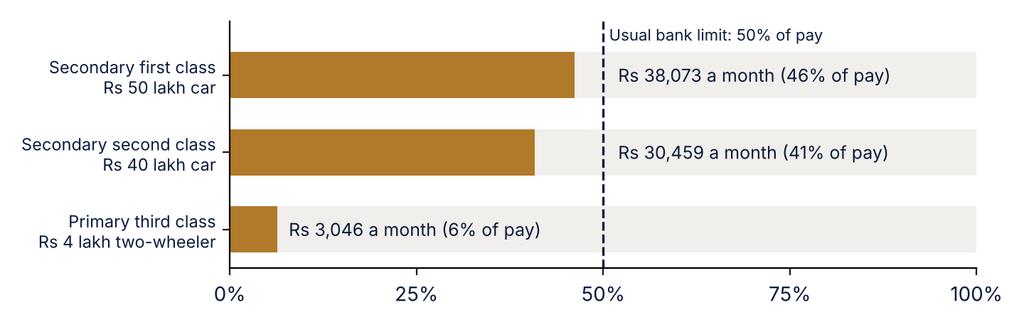
Pay includes the 10% incentive. The primary example uses Rs 43,428, the third class salary.
The car offer clears the bank’s monthly test only narrowly. Nearly half of take-home pay would go on the car for seven years, before fuel, insurance and repairs. The deposit is the real wall. Only teachers who already hold Rs 16 to 20 lakh in savings, land or family support can use the car tiers. The two-wheeler offer is within reach, but it is also where the state’s help is smallest.
The bigger the vehicle, the bigger the subsidy, and the fewer the teachers who can reach it. The benefit flows to those who already have money.
5. What it could cost taxpayers
The draft gives no figure, so we tested a range. The gold bars show the case where every buyer takes the largest car loan allowed. The slate bars show the case where every buyer takes the two-wheeler. The true cost lies between the two. The 50% and 100% rows are stress tests, since only secondary first and second class teachers qualify for cars.
Total interest paid by the state over 7 years (8.5% case)
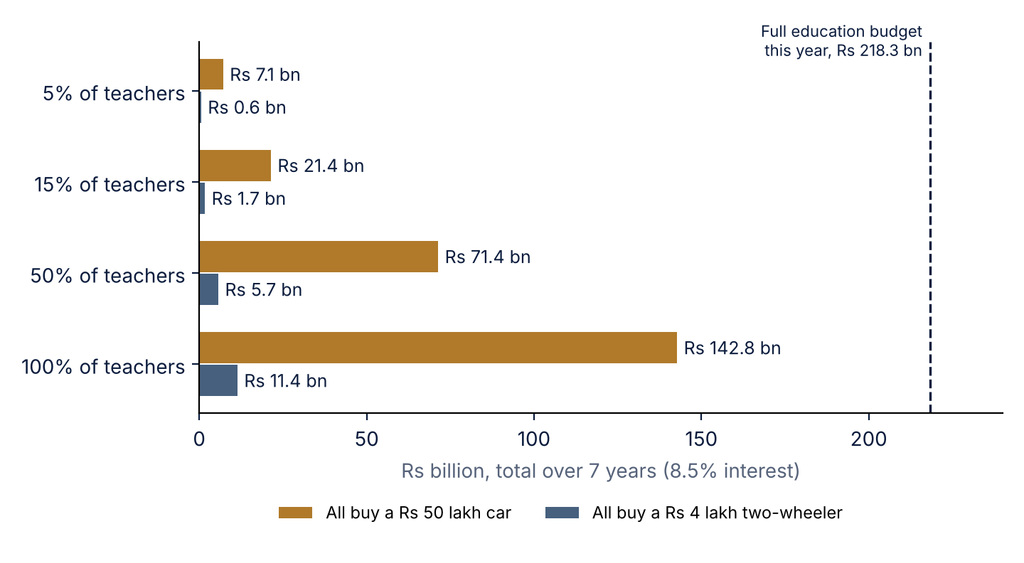
| Share of teachers | Buyers | Cars, 5% | Cars, 8.5% | Two-wheelers, 8.5% | New bank loans (cars) |
|---|---|---|---|---|---|
| 5% | 9,005 | Rs 4.0 bn | Rs 7.1 bn | Rs 0.6 bn | Rs 27 bn |
| 15% | 27,015 | Rs 12.1 bn | Rs 21.4 bn | Rs 1.7 bn | Rs 81 bn |
| 50% | 90,052 | Rs 40.5 bn | Rs 71.4 bn | Rs 5.7 bn | Rs 270 bn |
| 100% | 1,80,103 | Rs 80.9 bn | Rs 142.8 bn | Rs 11.4 bn | Rs 540 bn |
If only the 1,11,110 permanent positions qualify, multiply every figure by about 0.62. A longer loan period raises the cost further.
Banks have Rs 141.91 billion in vehicle loans outstanding today, of which Rs 46.10 billion is for passenger vehicles.13 At 15% take-up, teacher car loans alone would add Rs 81 billion, close to twice the entire passenger vehicle loan book.
There is also a payment risk. Under existing interest subsidy schemes, the government had fallen behind on payments to banks by about Rs 14 billion in early 2025, and banks charged borrowers the full interest in the meantime.19 A teacher who planned around a subsidy could end up paying full interest while waiting for the state.
6. Who gains and who loses
| Gains mostBanks. A large new pool of salary-backed borrowers, with most of the interest guaranteed by the state.Vehicle importers and dealers. Higher price limits steer buyers toward expensive cars rather than modest ones.Senior teachers who already have savings or family wealth, mostly in cities. They can pay the deposit, and they collect the largest subsidy. | Loses mostTaxpayers, who carry a cost that has not been published.Students, because every rupee here competes with an education budget where salaries already take 61.3%.Junior and primary teachers, who get the smallest benefit, and those in remote posts without roads, the very group the ministry names.Foreign exchange reserves, since every car is imported. |
When the largest gains go to lenders and sellers, and the stated beneficiaries struggle to use the offer, it is fair to ask whose priorities shaped the design. A draft that assumes 80% bank lending when the central bank allows 60% also suggests it was written without checking the rules it depends on. A popular announcement is easy to make. A published cost estimate is harder, and it is missing here.
7. What else the same money could do
We take the 8.5% car case and spread its cost over the 7 years of the loan. We compare it with the salary of a new secondary third class teacher, Rs 60,874 a month.5
| 1,396extra secondary teachers for 7 years, for the cost of the 5% scenario (Rs 1.02 bn a year) | 4,188extra secondary teachers for 7 years, for the cost of the 15% scenario (Rs 3.06 bn a year) | 22,000teachers that lower secondary and secondary levels are short of today10 |
For comparison, this year’s budget sets aside Rs 1 billion to identify infrastructure needs in community schools.12 The 5% car scenario alone (Rs 7.1 billion) is seven times that amount.
8. We have seen this before
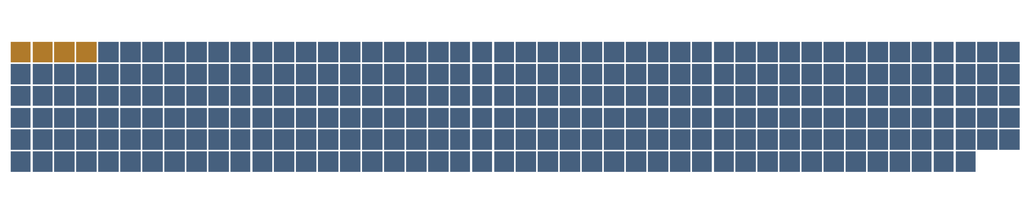
Between 2052 and 2054 BS, MPs and senior officials were allowed to import vehicles without customs duty. By Baisakh 2055, 210 MPs and 205 officials had imported vehicles this way, and the country lost nearly Rs 550 million in revenue.17 MPs choosing a Pajero or Prado saved Rs 19 lakh in customs and sales tax.17 Many could not afford the cars, so they imported them in their own names on behalf of businessmen and took a margin.18,20 The facility was revoked by the cabinet after Girija Prasad Koirala became prime minister in Chaitra 2054.17
Vehicles to scale, each square is about 100 vehicles
■ Pajero facility, 415 vehicles ■ Teacher scheme at 15% take-up, 27,015 vehicles
| Pajero facility (2052 to 2054 BS) | Teacher draft (2083 BS) | |
|---|---|---|
| Benefit | Customs exemption | Interest paid by the state |
| Who could use it | MPs and senior officials | Up to 1,80,103 teachers |
| Recorded or estimated cost | Rs 550 million | Rs 7.1 billion at only 5% take-up |
| Main risk | Names lent to businessmen | Same, plus unpaid subsidy arrears |
The two schemes share one design flaw. Each ties a benefit to a job title rather than a need, and each works best for those who already have money. The figures are in nominal rupees and not adjusted for inflation.
9. The case for the scheme
A fair reading should hear the other side. Teachers in hill and remote districts do face real travel hardship, and the two-wheeler limit could help them at a modest cost. Low interest rates make the timing attractive. If the rule were limited to electric vehicles, it would use Nepal’s surplus hydropower instead of imported fuel. Supporters may also argue that better perks help keep good teachers in public schools. These are reasonable goals. Our concern is that the car tiers serve them poorly and at a high price.
10. What we recommend before approval
- Publish a cost estimate with the number of eligible teachers in each class, the loan period and the interest rate assumed.
- Align the draft with Nepal Rastra Bank rules. Private vehicle loans are capped at 60% of the price, and the regulation should say so.
- Drop or cap the car tiers. Keep a two-wheeler or electric scooter benefit, which most teachers can actually use.
- Target by posting, not rank. Give priority to teachers in remote schools, the group the ministry says it wants to help.
- Ban transfer and name lending. Require the vehicle to stay registered to the teacher for the loan period.
- Clear existing subsidy arrears first, so new promises do not add to old unpaid ones.
METHOD
All loan figures are our own calculations using standard monthly instalments, checked against a month by month repayment schedule. Assumptions: 60% bank financing under current Nepal Rastra Bank rules, 7 year term, interest at 5% and 8.5%, government pays 80% of interest. Teacher counts, salaries, budgets and historical figures are taken from the sources below. Where sources disagree or are silent, we say so in the text.
REFERENCES
- HimalPress. “School teachers may get 80% interest subsidy on vehicle loans.” 9 October 2026. en.himalpress.com
- Ratopati. “Education Ministry proposes interest subsidy for teachers’ vehicle purchases.” October 2026. english.ratopati.com
- Khabarhub. “Govt proposes subsidized vehicle financing scheme for teachers.” 9 October 2026. english.khabarhub.com
- Bizmandu. “Teachers to get interest support to buy vehicles” (in Nepali). 9 October 2026. bizmandu.com
- Ratopati. “Government publishes new salary scale for community school teachers.” 6 August 2026. english.ratopati.com
- EducateNepal. “Salary scale of government community school teachers.” 6 August 2026. blog.educatenepal.com
- Ratopati. “New salary scale for employees approved.” 2026. english.ratopati.com
- Kantipur. “How was the community school demolished?” (opinion citing Ministry of Education report 2082). 30 June 2026. ekantipur.com
- Education International. “Education Fact Sheet: Nepal” (citing CEHRD Flash I Report 2022/23). June 2023. ei-ie.org
- HimalPress. “Government plan to solve teacher shortage through position matching” (in Nepali). 28 May 2026. himalpress.com
- Onlinekhabar. “Public education financing in Nepal, FY 2078/79 to 2083/84.” 2026. english.onlinekhabar.com
- Ratopati. “Government allocates NPR 218.3 billion for education sector in FY 2083/84.” 29 May 2026. english.ratopati.com
- Meroauto. “Low interest rates push Nepal’s vehicle financing to eight-year high” (citing Nepal Rastra Bank). 15 July 2026. en.meroauto.com
- Meroauto. “Nepali banks roll out sub-5% auto loans: a look at current rates.” September 2026. en.meroauto.com
- Global IME Bank. “The ultimate guide to car loan in Nepal.” globalimebank.com
- Meroauto. “Government employees to get interest-free vehicle loans of up to Rs 6 million.” 14 July 2026. en.meroauto.com
- Kantipur Archive. “The 550 million rupees in revenue lost by granting customs privileges to MPs.” Republished 10 July 2026. ekantipur.com
- Kantipur Archive. “How do MPs who can’t afford a Maruti buy a Pajero?” Republished 19 February 2026. ekantipur.com
- Kantipur. “14 billion of interest subsidy given by the government” (arrears unpaid). 5 January 2025. ekantipur.com
- Nepali Times. “Shamelessness” (editorial on the Pajero facility). nepalitimes.com
- Business 360. “Monetary policy mid-term review: vehicle loan ratio lowered to 60 pc.” 26 February 2025. b360nepal.com
- Meroauto. “Nepal Rastra Bank holds firm on auto lending policy.” 26 February 2026. en.meroauto.com
- NEPSE Trading. “NRB raises loan limit for electric public transport to 80 percent.” 16 July 2026. nepsetrading.com
Catalyst Club Nepal · catalystxclub.com · Kathmandu
Gayatri Interdisciplinary Research Institute (GIRI) · girinstitute.org · Kathmandu
