A country responsible for roughly one-thousandth of the warming now buries its dead by the thousand. On 24 September, Balendra Shah has one afternoon at the United Nations to convert that grief into something the world can actually be held to.
Compiled by Dr Rishav Shrestha | Contributors: Deepak Dahal, Er. Anup KC, Dr Prabhat Adhikari
On behalf of The Catalyst Club (Think Tank) · catalystxclub.com · 12 September 2026
RAJENDRA DHUNGANA FELT THE GROUND SHAKE on the morning of 26 August and assumed it was an earthquake. Nepal’s chief customs officer in Rasuwa ran outside and saw something he had no vocabulary for: a wall of water perhaps a hundred metres high, trailing what looked like smoke, coming down the valley. Timure bazaar, he later told Kantipur, was gone in a jiffy.
What reached Timure had begun some hours and several kilometres earlier, high in the Lhende catchment on the Nepal–China border. A section of glacier roughly 600 metres wide, resting on failing bedrock at around 5,200 metres, broke away and fell some 1,200 metres into the valley. ICIMOD’s cryosphere specialist Mohd. Farooq Azam puts the mass at 100 to 200 million cubic metres — between forty and eighty thousand Olympic swimming pools of rock and ice. The impact was violent enough that the United States Geological Survey first logged it as an earthquake, then revised its assessment: the seismic signal, equivalent to magnitude 5.2, was the mountain itself coming down.
The debris dammed the Lhende. Water piled up behind it. When the dam failed, the river did not rise so much as detonate. Gauges at Galchhi recorded roughly nine metres in thirty minutes; Malekhu, seven. Bodies were later recovered in Nuwakot, Dhading, Chitwan, Gorkha, Tanahun and both Nawalparasis — hundreds of kilometres downstream, through the Trishuli and into the Narayani.
As of 11 September, 1,385 bodies had been recovered. Some 5,130 people remain unaccounted for, among them around 600 foreign nationals from roughly 35 countries. About 1.6 million Nepalis have been affected. It is the deadliest disaster to strike Nepal since the 2015 earthquake, and unlike the earthquake, it arrived in a valley that had been warned about.
Prime Minister Balendra Shah will address the 81st session of the General Assembly on the afternoon of 24 September — his first foreign trip since taking office on 27 March. The Cabinet had originally planned to send the foreign minister. After 26 August, Shah decided to go himself. Foreign Secretary Amrit Bahadur Rai has said the address will press the case for climate justice and for compensation through the Fund for responding to Loss and Damage, to which Nepal has already submitted an urgent request.
That is the right instinct. But instinct is not a strategy, and a General Assembly speech is an unforgiving format: twenty minutes, a half-empty hall, and a global press corps that has heard small countries ask for help before. The question is not whether Nepal has a case. It is whether Nepal arrives with a case that can be audited, financed and enforced — or with a eulogy.
I. First, put the ledger on the table
Nepal’s most powerful asset in New York is not rhetoric. It is arithmetic that has already been done. On 10 September, a joint technical team led by the National Planning Commission and the National Disaster Risk Reduction and Management Authority published a Rapid Damage and Needs Assessment putting recovery at Rs723.31 billion — roughly US$5.1 billion. It was built from Department of Roads data, Central Bureau of Statistics comparisons of pre- and post-flood conditions, ministry returns and drone survey.
| Recovery requirement by sector | Rs billion | What it covers |
|---|---|---|
| Energy and grid restoration | 390.62 | 13 hydropower projects, 5 solar plants, substations, transmission |
| Disaster-risk reduction, river management | 94.75 | Channel works, protection structures |
| Housing, public buildings, services | 103.54 | 7,570 homes; 48 public buildings; 18 schools; 7 health facilities; 30 heritage sites |
| Transport | 73.34 | 69 km roads; 33 motorable bridges lost, 4 damaged; 53 of 64 footbridges |
| Productive sector | 50.77 | 1,806 ha of crops; ~4,800 businesses; 17 bank branches |
| Debris and mud clearance | 0.52 | Immediate site works |
| Total identified need | 723.31 | ≈ US$5.1 billion |
Figure 1 — The bill. Rapid Damage and Needs Assessment, National Planning Commission and NDRRMA, 10 September 2026. The government has split delivery into Rs8.73 billion of immediate and six-month works and Rs714.58 billion of long-term reconstruction. A fuller Post-Disaster Needs Assessment, with World Bank participation, is due within a month and the figure could rise if whole settlements must be relocated.
Two numbers in that table deserve to be said aloud in New York. The first is Rs390.62 billion for energy — because roughly 783 megawatts of generating capacity was knocked out in a single morning, close to one in every five megawatts Nepal has installed. Thirteen hydropower projects were hit: Rasuwagadhi, Chilime, the Upper Trishuli cascade, Devighat, Mailung Khola and others, some operating, some still under construction. At Upper Trishuli-1 alone, more than a hundred workers were unaccounted for in the first days. Nine days after the flood, survivors were pulled alive from a tunnel at Trishuli-3A.
The second is the comparison the Prime Minister should make explicitly. Nepal lost hydropower to floods and landslides in 2021, 2023 and 2024 — some Rs18.5 billion in cumulative direct losses across three monsoons, as ICIMOD’s Arun Bhakta Shrestha and former National Planning Commission member Ramesh Ananda Vaidya have documented. One morning in August cost the energy sector more than twenty times all three years combined. That is what a step-change in hazard looks like on a balance sheet.
II. The asymmetry, stated precisely
Every Nepali delegation for twenty years has said that Nepal emits almost nothing and suffers enormously. It is true, and it has stopped landing, because it is usually said imprecisely. Precision is what makes it land.
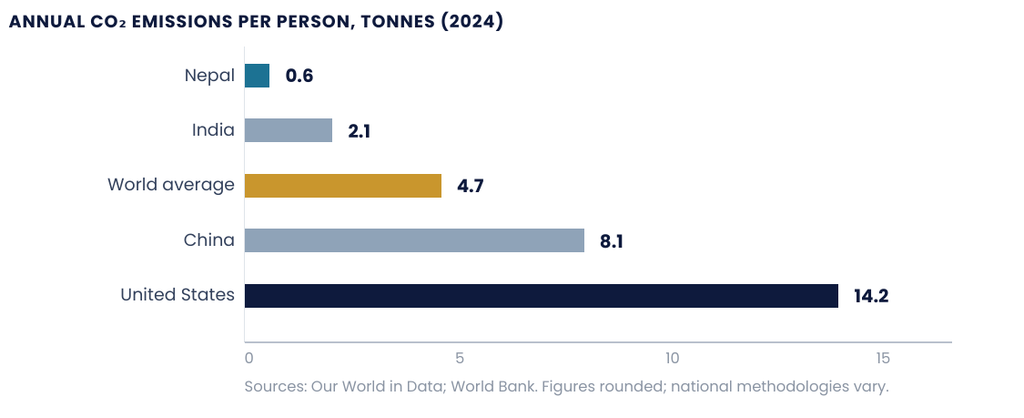
Figure 2 — One thousandth of the problem. Nepal emitted about 18.8 million tonnes of CO₂ in 2024 — some 0.05 per cent of the global total, or around 0.1 per cent counting all greenhouse gases, the figure the World Bank uses when it calls Nepal a negligible contributor to climate change. Cumulatively, since 1751, Nepal accounts for roughly 0.01 per cent of all carbon dioxide humanity has emitted.
Set that against what is happening to the mountains Nepal lives on. Across the Asian Water Tower, temperatures are rising by about 0.44°C per decade — roughly twice the global rate. Between 1990 and 2020, Hindu Kush Himalaya glaciers lost around 12 per cent of their area and 9 per cent of their ice reserves; since 2000 they have been losing ice at double the earlier rate. Nepal has 46 per cent forest cover and has legislated a net-zero target for 2045.
Nepal has contributed one part in ten thousand of the carbon in the atmosphere and is being charged the full price of it.
III. Be honest about the science — it is stronger that way
Here the Prime Minister faces a genuine temptation, and he should resist it. It would be easy to stand at the rostrum and say that climate change caused the Bhotekoshi flood. The scientists who study these mountains will not say that yet, and if Nepal overstates the claim, every subsequent number in the speech becomes contestable.
Jeff Da Costa of the University of Reading puts it carefully: warming is changing glaciers, permafrost and slope stability across the Himalayas, so it is an important background risk — but this individual collapse cannot be attributed to climate change without further analysis. Upmanu Lall of the Columbia Water Center describes the plausible mechanism rather than asserting it: persistent warming, or rain falling where snow used to, saturates the slope beneath a glacier until it fails. Sunwi Maskey of ICIMOD notes the trend that is not in dispute — glaciers that would historically have taken centuries to change are visibly retreating within a human lifetime.
Nepal’s case does not need single-event attribution, and it is a mistake to rest it there. The case rests on the distribution: a cryosphere warming at twice the global rate, glaciers losing mass at an accelerating rate, expanding glacial lakes, degrading permafrost, and a documented sequence of cascading Himalayan disasters — Chamoli in 2021, the Tibet-origin flood that destroyed the 45 MW Upper Bhotekoshi plant in 2016, the Tamakoshi blockage of 2021, a glacial lake outburst on this very river in July 2025, and now this. Shah should say plainly: we do not claim to know which single storm the ocean sent; we know the sea level has risen. Delivered that way, the argument becomes unanswerable rather than merely loud.
IV. Ask for money in three separate currencies — and do not blur them
The most consequential decision in this speech is structural, not rhetorical. Nepal is currently carrying two different headline numbers into New York. One proposal circulating among Nepali policy contributors calls for a US$200 billion climate compensation and investment compact through 2050, anchored on Nepal’s own published plans — US$73.74 billion in mitigation costs under NDC 3.0 and US$47.4 billion in adaptation costs under the National Adaptation Plan — and on the World Bank’s warning that unchecked climate impacts could leave Nepal’s GDP at least 7 per cent smaller by 2050. Another proposes a US$20 billion, ten-year Himalayan Climate Resilience and Loss & Damage Initiative, itemised across recovery, glacier science, early warning, preventive engineering and watershed protection.
Both are defensible. Presented side by side without a hierarchy, they will read as improvisation, and the first question from any finance ministry in the room will be which number Nepal actually means. The fix is straightforward: make the smaller number the ask and the larger number the horizon.
| Instrument | Scale | What it pays for | What Nepal must accept in return |
|---|---|---|---|
| Compensation & recovery grants Loss and Damage Fund, bilateral | US$5.1 bn immediate, against the RDNA | Rebuilding homes, schools, health posts, bridges; livelihood restoration; relocation where valleys can no longer be safely occupied | Independent verification; a National Climate Loss and Damage Accounting System; published disbursement and beneficiary data |
| Himalayan resilience facility Concessional, multi-donor, decadal | US$20 bn over ten years | Glacier and glacial-lake monitoring; multi-hazard early warning; preventive engineering; debris and sediment works; watershed protection | Regional governance with China and India at the table; open data; measurable risk-reduction milestones |
| Commercial investment FDI, DFI risk-sharing, blended finance | Toward the US$120 bn+ of costed national need to 2050 | Hydropower and transmission, resilient settlements, agri-processing, health manufacturing, digital planning infrastructure | Enforceable contracts, predictable tax, reliable profit repatriation, timely dispute resolution |
Figure 3 — Three currencies, three sets of rules. The distinction is not pedantry. Commercial capital earns a return and cannot discharge a compensation obligation; grants are not investment and should not be scored as such. A compact that lets donors count a power-plant equity stake against a loss-and-damage claim will collapse the first time it is audited.
And the US$200 billion figure, if used at all, must be introduced honestly — as a provisional negotiating target for compensation, recovery and transformation to 2050, to be substantiated by an independent national loss-and-needs assessment, not as an audited damage total. Nepal should publish its assumptions and strengthen the claim as evidence improves. A number that cannot survive scrutiny is worse than no number, because it teaches the room to discount everything else.
V. The Himalayan ask: make information cross borders faster than water does
This is the part of the speech that only Nepal can deliver, and it is the part most likely to survive as policy.
The flood that killed Nepalis on 26 August started as an avalanche on Nepali territory, crossed into Chinese territory, and caused damage on both sides. Glaciers do not recognise borders; neither do glacial lakes, rivers or debris flows. A joint ICIMOD–UNDP assessment identified 47 potentially dangerous glacial lakes across the Koshi, Gandaki and Karnali basins: 21 in Nepal, 25 in the Tibet Autonomous Region of China, and one in India. A majority of the lakes that could kill Nepalis are not in Nepal.
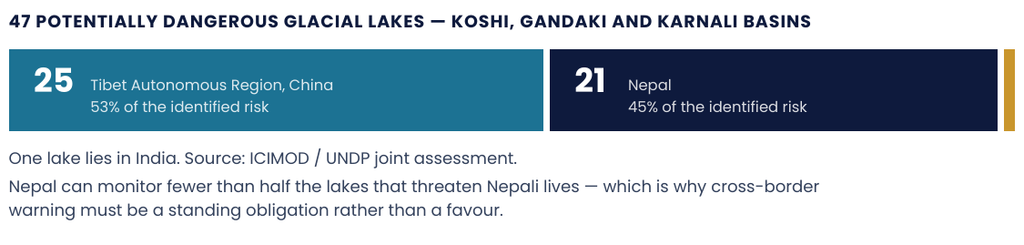
Figure 4 — The risk is shared; the deaths are not.
Nepal’s warning system did work on 26 August — it simply worked too late to matter. Authorities issued SMS alerts. But Nepal tracks floods well once they enter monitored rivers and detects the high-mountain events that create them poorly, and by the time a downstream gauge registers a catastrophic rise, the useful warning time is gone. As Da Costa observes, for an event of this magnitude you are talking about minutes, not hours or days. Later, information from Chinese authorities that water remained impounded upstream allowed the NDRRMA to warn of a possible second pulse. Had comparable information moved earlier, it might have bought the evacuation time that Timure never had.
So the Prime Minister should arrive with a specific, unglamorous, entirely achievable proposal: a standing Himalayan mountain-hazard mechanism with 24-hour contact points, agreed alert thresholds, and rapid sharing of satellite and monitoring data — extending beyond weather to river blockages, abnormal flow changes, glacial-lake instability, landslides and ice-rock avalanches. Nepal’s Department of Hydrology and Meteorology and the China Meteorological Administration reportedly agreed to strengthen information-sharing within hours of the flood. That agreement should be named from the rostrum, welcomed, and proposed as the nucleus of something permanent and trilateral.
Warning is only half of it. Detection must connect to pre-agreed action — hydropower plants shutting down safely, bridges closing, communities moving to known high ground on routes they have rehearsed. And where a valley cannot be evacuated in the minutes available, Nepal must say the harder thing: some places should not be rebuilt. Repeatedly reconstructing in corridors known to be lethal is not adaptation. It is accepting preventable death and calling it resilience.
The deliverable: turn Bhotekoshi into a demonstration corridor
Rather than asking the Assembly to note Nepal’s suffering, Shah should ask it to fund a proof of concept. The Bhotekoshi–Trishuli corridor can become an internationally financed demonstration of Himalayan climate resilience: source-level glacier monitoring, multi-hazard detection, early-warning-to-operation protocols, debris and sediment management, climate-resilient hydropower reconstruction, and community preparedness — all instrumented, all published, all replicable from the Karakoram to Arunachal. A model costs money once. A tragedy costs money every monsoon.
VI. Ask for investment more loudly than for aid
Here is the uncomfortable statistic Nepal should put in front of the world’s investors, because it is the one that changes the conversation from charity to opportunity. In the last fiscal year, Nepal Rastra Bank recorded gross foreign direct investment inflows of Rs12 billion. Investors repatriated Rs4.7 billion of it — some 39 per cent of the gross — leaving net inflows of Rs7.3 billion. Against Rs65 billion of approved commitments, that is a realisation rate of roughly 11 per cent. Total FDI stock stands at about Rs340 billion and grew 2.1 per cent last year, down from 12.7 per cent the year before. Sixty-four per cent of it sits in Bagmati Province; Karnali holds 0.3 per cent.
Meanwhile South Asian FDI surged 35.4 per cent in 2025 to US$46.1 billion. Nepal’s share of that is a rounding error — not because capital dislikes Nepal, but because capital cannot price discretionary approvals, uncertain profit repatriation and rules that change with the minister. The World Bank has said so in three consecutive updates.
And yet the underlying asset is exceptional. Nepal’s technically and economically feasible hydropower potential is around 43,000 MW; installed capacity is roughly 4,200 MW against peak domestic demand of 2,000–2,200 MW. In the fiscal year ending mid-July, Nepal became a net electricity exporter for the first time in nearly a decade of cross-border trade, earning Rs18.75 billion — about US$142 million. Cross-border power purchase agreements with India have historically settled around INR 4–5 per kilowatt-hour, making Nepali run-of-river hydro among the lowest-cost sources of firm renewable electricity in South Asia. Some 281 projects with a combined 16,500 MW are queued for power purchase agreements that have stalled.
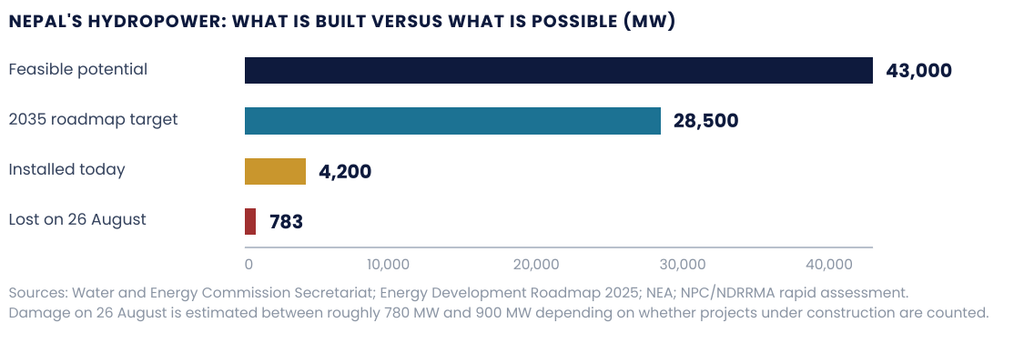
Figure 5 — The gap is the offer. Nepal has built under a tenth of what is buildable. The Energy Development Roadmap 2025 targets 28,500 MW by 2035, of which 15,000 MW for export. That gap, not Nepal’s poverty, is what should be marketed in New York.
The proposition writes itself: Nepal is not asking the world to fund a deficit. It is asking the world to finance the cheapest clean electricity in the fastest-growing energy market on earth, and to make it safe enough to bank. The two halves are inseparable. No sensible lender will finance a run-of-river plant in a valley whose glacial hazard is unmonitored. Resilience finance and investment finance are the same conversation, which is precisely why the Prime Minister should refuse to hold them separately.
But that offer is only credible if the domestic half is delivered, and Shah should commit to it on the record, in New York, where the commitment becomes enforceable. Simplify registration. Publish approval deadlines and honour them. Make lawful repatriation of profits administratively reliable rather than discretionary. Give investors enforceable contracts and timely dispute resolution. Unstall the PPA queue. He should also extend the invitation to Nepalis abroad, whose savings, networks and institutional experience are the most underused capital Nepal has — which means confronting the constitutional question of citizenship rights for overseas Nepalis who have taken another nationality. And he should say what every investor privately wants to hear from a government born of a popular uprising: that money will be accounted for, contracts published, and fraud prosecuted.
VII. Non-alignment as a commercial position, not a defensive crouch
Nepal sits between the world’s two most populous economies, and the standard formulation — equidistance, balance, non-alignment — is usually delivered apologetically, as though it were a constraint. Shah should reframe it as a market position.
The facts are in Nepal’s favour. The flood originated in a transboundary catchment shared with China, and Chinese data helped Nepal warn of a second surge. The electricity Nepal exports flows south to India and Bangladesh. Chinese and Indian capital together account for the majority of FDI commitments to Nepal. Nepal’s diplomacy runs through the Least Developed Countries group, the landlocked developing countries, the Non-Aligned Movement and the G77 — all of which Foreign Minister Shisir Khanal will work in New York, and all of which contain states with the same grievance and no coordinated ask.
The line to deliver is that Nepal does not audition for patrons. It sells electrons, watershed services, verified carbon removals and a stable place to put long-term money — to anyone, on published terms, on the same terms. Nepal will take Indian capital and Chinese capital and Gulf capital and European capital, and will not permit any of them an exclusive concession over a public landscape. Non-alignment stated that way is not a plea to be left alone. It is an auction.
One practical note on expectations. Neither the Indian nor the Chinese leader is travelling to New York, and Nepali officials report no confirmed bilaterals beyond the meeting with Secretary-General Guterres. This speech will not be won in side rooms. Its audience is the multilateral finance system, the vulnerable-country blocs, and the international press — which means the text itself, and the concrete asks inside it, are the entire instrument. Nepal’s side event on 25 September, Sagarmatha to the Sea, is where the detail should land.
VIII. What he must not do
Four ways to lose the room
- Inflate the numbers. The RDNA figure is credible because it is methodologically sourced and explicitly preliminary. Attaching a larger, unsourced figure to it contaminates both.
- Over-attribute the single event. Scientists will not yet say climate change caused this collapse. Nepal’s argument is stronger on the trend than on the instance, and a claim that gets corrected in print costs more than it earns.
- Ask only for sympathy. Every delegation in that hall has a disaster. What distinguishes a country is arriving with a costed portfolio, a governance structure, and a timetable.
- Promise reform without a date. Commitments without deadlines are how previous Nepali governments lost investor credibility. Publish a first project portfolio within 100 days, conclude initial partnership agreements within six months, and report quarterly on money received, contracts awarded and milestones missed.
IX. The part that is not about money
There are 5,130 people still unaccounted for. Twenty of the first 669 recovered were identified before Nepal began preparing mass burials. Four health posts in Rasuwa are gone — Syaphrubesi, Timure, the health desk at Rasuwagadhi, Mailung. Eight schools were destroyed, eight damaged, three left standing; 6,901 students across three districts have nowhere to sit. In Nuwakot’s Bidur Municipality alone, 3,026 homes were damaged, and 4.5 kilometres of the drinking-water pipeline that served 4,000 households simply is not there any more.
None of this appears in a loss-and-damage claim in any form a spreadsheet respects. Grief, dissolved communities, a child who will be told for years that a parent is missing rather than dead, the Langtang National Park offices that recorded a way of living in that valley — the UNFCCC’s own technical work on non-economic losses acknowledges these categories without assigning them a value. They should be read into the record anyway, because a balance sheet that omits them teaches the world that what happened in Rasuwa was an infrastructure event.
It was not. It was a morning when a mountain that had been getting weaker for decades, for reasons Nepal did not cause, fell into a river and took a town with it.
The children of Nepal did not create this crisis and cannot negotiate their way out of it. What they can inherit is a country that turned one speech into a system.
Balendra Shah came to office in March on a mandate for competence after a movement that demanded it. He has a single afternoon in front of the only assembly where all 193 states sit in one room. The measure of that afternoon will not be how movingly he describes the dead. It will be whether, twelve months from now, there is a monitoring station above the Lhende, an alert protocol that names who calls whom, a reconstruction that did not rebuild in the flood path, and a line of foreign capital waiting for a power purchase agreement that actually gets signed.
Grief is not a policy. But it is, briefly, leverage. Nepal should spend it well.
Sources and notes
- National Planning Commission / NDRRMA, Rapid Damage and Needs Assessment, reported 10 September 2026; casualty and displacement figures as of 11 September 2026. A fuller Post-Disaster Needs Assessment with World Bank participation is pending.
- Reporting on the flood, its mechanism and the government response: The Kathmandu Post, 26 August – 12 September 2026, drawing on ICIMOD, the Columbia Water Center, the University of Reading, USGS and Planet Labs imagery.
- Y. Pokhrel and S. Aryal, “The flood crossed a border. Our warning systems must too,” The Kathmandu Post, 27 August 2026; and the authors’ synthesis in Water Security on the Nepal–Bhutan–Tibet corridor.
- A. B. Shrestha and R. A. Vaidya, “Why climate change is a threat to Nepal’s hydropower sector,” The Kathmandu Post, 4 September 2026.
- Government of Nepal, NDC 3.0 (2025) and National Adaptation Plan 2021–2050 (2021): US$73.74 bn mitigation and US$47.4 bn adaptation; the arithmetic sum requires reconciliation, and quantified mitigation costs extend only to 2035. The US$200 billion figure in Section IV is a proposed negotiating target informed by these plans — not an audited loss estimate or an established entitlement; the US$20 billion decadal initiative is a separate, itemised proposal.
- World Bank, Nepal Country Climate and Development Report (2022): unchecked climate impacts could leave GDP at least 7 per cent smaller by 2050 — a projected GDP-level difference, not a current annual loss.
- UNFCCC, Technical Paper on Non-Economic Losses (2024).
- Nepal Rastra Bank, Foreign Direct Investment in Nepal 2024/25: A Survey Report (September 2026); UNCTAD World Investment Report 2025 and 2026.
- Emissions data: Our World in Data and World Bank (2024). ICIMOD press releases on Hindu Kush Himalaya glacier loss.
- Energy figures: Water and Energy Commission Secretariat; Nepal Electricity Authority; Energy Development Roadmap 2025; The Kathmandu Post, 23 August 2026.