Five priorities to complete the reform agenda of Budget 2083/84
Dr Prabhat Adhikari and Er Anup Khattri Chhetri
The Catalyst Club (Think Tank) and Gayatri Interdisciplinary Research Institute (GIRI), Kathmandu
catalystxclub.com
This brief was prepared for the Ministry of Finance, Government of Nepal, and is shared publicly to support informed debate. All figures were cross checked against the sources listed at the end on 14 October 2026.
Five priorities, and the question behind each
All five are within executive or ordinary legislative reach. None needs a constitutional amendment.
| Priority | What we propose | The question |
| 1. Revise the FITTA negative list | Keep closed only what security and local livelihoods require; open the rest by Gazette notice under FITTA s.50. | Can the Schedule be revised this fiscal year? |
| 2. Open FDI to SMEs and technology | Remove the Rs 2 crore minimum, as already done for IT; count IP as equity; allow third party manufacturing. | Can the minimum go for SMEs, as it did for IT? |
| 3. Table a Credit (Prompt Payment) Act | Unpaid dues are pushing viable firms out. NRB has said it is positive about a credit law. | When can the Bill be tabled? |
| 4. Let Nepalis abroad invest and work freely | Deliver the budget’s “Once a Nepali, always a Nepali”. Economic rights need ordinary law, not a constitutional amendment. | When will NRNs invest as Nepalis? |
| 5. Reward firms that earn foreign currency | Let exporters keep their earnings in foreign currency, as India allows 100%; inputs at world prices; tools that stay WTO compatible. | Can earners keep what they earn? |
Already moving: bank level repatriation (NRB, December 2025); FITTA amendment announced; automatic route uncapped (2026); NRN share issues (SEBON, October 2026); 50% tax exemption on IT exports.
Nepal is not short of money. It is short of productive investment.
FDI matters for what it carries: technology, management, brands and export markets.
| Indicator | Value | Source |
| Remittances, FY 2082/83 | Rs 2,363 bn, up 37.1%; about 36% of GDP | NRB; NSO preliminary GDP [3] |
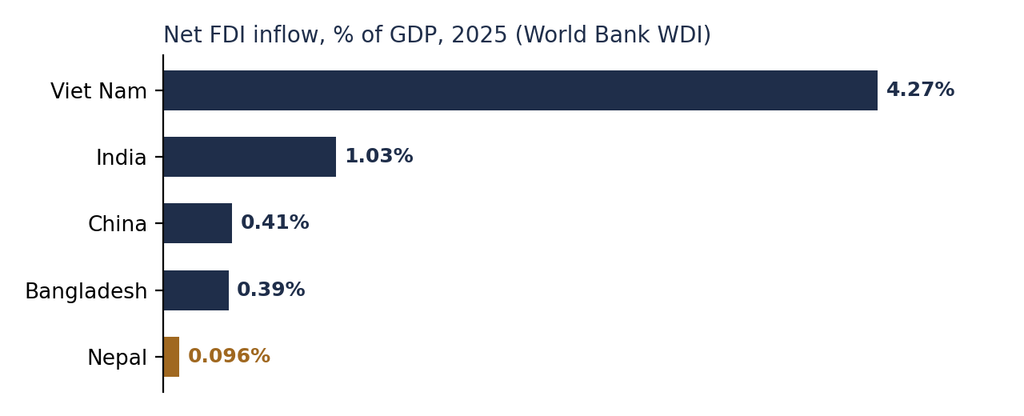
| Net FDI, 2025 | US$43.5 m; 0.096% of GDP | World Bank WDI [1] |
| Manufacturing, 2025 | 5.0% of GDP | World Bank WDI [1] |
| Imports to exports, FY 2082/83 | 6.65 to 1 | Department of Customs [9] |
| Approved FDI that arrived, FY 2024/25 | 11.25%, down from 60.6% five years earlier | NRB FDI Survey [2] |
| Dividends repatriated by FDI firms | Rs 33.9 bn, almost three times new inflow | NRB FDI Survey [2] |
| Remittance income used for capital formation | 1.2% (15.8% repays loans) | NLSS IV [4] |
PRIORITY 1
Revise the FITTA negative list
The Schedule closes the sectors where Nepal’s advantages lie. It is amended by Gazette notice (FITTA s.50): no Act of Parliament is needed. The eleven heads below are those of the Schedule as published for investors by Reanda Biz Serve (bizserve.com.np). Heads 1, 2, 6 and 8 cost most: they close agriculture, small firms, tourism services and the professional services through which skills usually enter.
| # | Head of the negative list | Verdict |
| 1 | Primary agriculture, livestock, fisheries, bees, fruit, dairy | Amend |
| 2 | Cottage and small industries | Remove |
| 3 | Personal services (hair, tailoring, driving) | Keep |
| 4 | Arms, explosives, NBC weapons, atomic energy | Keep |
| 5 | Real estate, retail, courier, catering, money changing, remittance | Narrow |
| 6 | Travel agencies, trekking guides, rural tourism, homestays | Amend |
| 7 | Mass media and national language films | Keep |
| 8 | Management, accounting, engineering, legal consultancy; language, music, computer training | Amend |
| 9 | Consultancy above 51% foreign owned | Amend |
| 10 | Ride sharing above 70% foreign owned | Review |
| 11 | Aviation caps (domestic 49%, international 80%) | Keep |
What a revised list would look like
| Proposal | |
| Keep closed | Arms, ammunition and nuclear materials; real estate speculation; money changing and remittance; national language mass media; personal services and micro trades, reserved for Nepalis and NRNs |
| Open | Primary agriculture and agri processing; small industry; tourism services (guide licences stay with Nepalis); management, engineering and accounting consultancy; language, music and computer training |
| Caps | Keep the aviation ownership caps; review the 51% cap on consultancy where skills transfer is committed |
| How | The Schedule is amended by Gazette notice under FITTA s.50; no Act of Parliament is needed |
A short list closed for security and local livelihoods; everything else open by right. There is no general ownership cap today (FITTA s.13(1)).
PRIORITY 2
Open FDI to SMEs and technology
The Rs 2 crore minimum is set by Gazette notice under FITTA s.3(3). For IT it is already zero, and investors came.
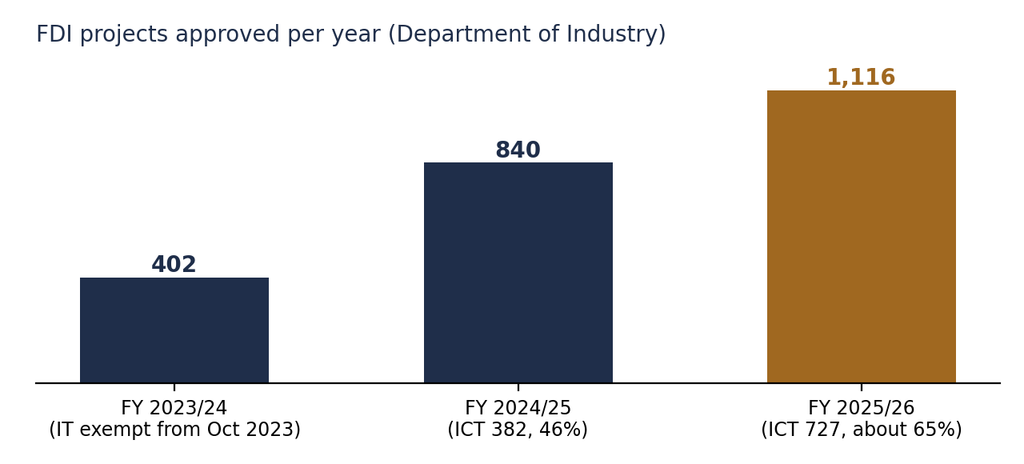
These are approvals, not yet inflows; DOI and NRB should publish realisation by sector [5].
▪ Remove the minimum for SMEs and technology transfer. It applies per investor, so four partners backing one start up must each bring Rs 2 crore. Indonesia cut its minimum capital per business activity by 75% in October 2025 [12].
▪ Technology as equity. Since 2025 the Companies Act allows shares for IP and know how, independently valued, up to 20% of paid up capital (40% for start ups). DOI and NRB should confirm by circular that foreign investors can use it [23].
▪ Third party (contract) manufacturing. FDI firms may contract out their main product since 2024 (FITTA s.45), but the implementing rules are missing and domestic firms are still barred (Industrial Enterprises Act s.50). India allows 100% FDI in contract manufacturing (2019) [21].
| Zero minimum for SMEs, technology and Nepalis abroad; personal services stay reserved for Nepalis. |
PRIORITY 3
Table a Credit (Prompt Payment) Act
Firms that do not fail in the market are failing on unpaid dues.
Entrepreneur Pavitra Bahadur Gautam has warned that Nepal’s credit culture is hurting entrepreneurship, and that unpaid dues have forced some entrepreneurs to leave Nepal although their businesses were not failing in the market (as reported, October 2026).
▪ NRB is supportive. The NRB Governor said the central bank is positive about bringing a credit law that the private sector has demanded (12 March 2026) [15].
▪ Maximum payment terms: 45 days for large buyers and every government body, as India’s MSMED Act 2006 sets [16].
▪ Automatic interest on late payment: India sets three times the bank rate; the EU sets 8 points above the reference rate [16].
▪ Fast adjudication within 90 days, outside regular courts.
▪ Invoice discounting platform so SMEs can sell receivables, as India’s TReDS [16].
▪ Government pays first: publish and clear the state’s own arrears to contractors and suppliers.
| When can the Bill be tabled? It costs the treasury little and keeps SMEs alive. |
PRIORITY 4
Let Nepalis abroad invest and work freely
Budget 2083/84 commits to “Once a Nepali, always a Nepali” and to all forms of economic, social and cultural rights for NRNs [7].
What blocks it today
▪ FITTA s.2 lists NRNs as foreign investors: the minimum, the negative list, approvals.
▪ FITTA recognises only the NRN card, not NRN citizenship (issued since September 2023).
▪ Non residents pay 25% capital gains tax on listed shares, residents 7.5 to 10%.
▪ Article 14 already lets ordinary law give NRN citizens economic rights: no constitutional amendment is needed.
The fix: two accounts, one rule
▪ Foreign currency account: money earned abroad invests on the same terms as a Nepali investor and is fully repatriable.
▪ Rupee account: inheritance and local income treated as domestic; up to US$1 million a year out, as India allows.
▪ Heirs inherit the right to repatriate; children and grandchildren born abroad qualify through NRN citizenship (Art. 14).
▪ Evidence: India’s NRI deposits stood at US$200.9 bn (July 2026); Pakistan’s Roshan Digital Account, set up by one central bank circular while Pakistan was on the FATF grey list, has drawn US$13.65 bn [13].
PRIORITY 5
Reward firms that earn foreign currency
Imports are 6.65 times exports. Manufacturers and service exporters earn what the economy lacks.
Tools that stay WTO compatible
▪ Keep what you earn: let every exporter hold a share of earnings in a foreign currency account. Today NRB lets IT and service exporters use up to 10% of last year’s earnings abroad; India allows exporters to keep 100% in EEFC accounts; Bangladesh 15% [20].
▪ Third party manufacturing: let Nepali firms make for brand owners and exporters, and issue the missing rules, including drug loan licences with GMP audit, as India does [21].
▪ Inputs at world prices: bonded warehouses, fast duty drawback, a line by line tariff inversion audit; VAT refunds within 30 days.
▪ Power and credit: pass the wet season surplus to producers (Rs 29.3 bn of electricity exported in FY 2025/26) [9]; priority on the World Bank backed credit guarantee [18].
Design caution
▪ After LDC graduation, subsidies contingent on exports, such as a lower tax rate only for exporters, are prohibited under WTO rules [17].
▪ Nepal has requested deferral of graduation to 2029; the UN decision is pending [17].
▪ So reward earners through retention, inputs, refunds, power and credit, not export contingent tax rates.
ENABLER
Protect the technology we invite in
Nepal still runs patents and trademarks under a 1965 Act, outside the two treaties investors use most.
| Treaty | Nepal | Peers |
| Paris Convention | Member since 2001 | All peers |
| Berne Convention (copyright) | Member since 2006 | All peers |
| Madrid Protocol (trademarks) | Not a member | Bhutan 2000, Viet Nam 2006, Cambodia 2015, Lao PDR 2016 |
| Patent Cooperation Treaty | Not a member | Sri Lanka 1982, Viet Nam 1993, Lao PDR 2006, Cambodia 2016 |
Nepali applicants filed 5 patents abroad in 2024, and Nepal does not report resident filings to WIPO. After joining Madrid in 2015, Cambodia’s monthly designations rose from 18 to 162 within six months [22].
▪ Join the Madrid Protocol first: one filing protects a brand in many markets, with no new examination capacity.
▪ Then the PCT: Nepal acts as a receiving office; WIPO supports LDC accession.
▪ Pass the Industrial Property Bill (registered June 2025): one IP office, online filing, trade secrets and geographical indications.
▪ Ease royalty caps (now 5% of sales, 10% on exports) where technology comes with training [23].
▪ Use the TRIPS pharmaceutical window before graduation: voluntary licences now, compulsory licence provisions in the new law [24].
Open the small door. Screen the big door.
Opening for investment does not mean opening jobs or strategic assets.
| Security | Jobs | Certainty |
| Screening for defence, border land, power grid, telecom and data, media | Skilled entry only: local hiring first, as Labour Act s.22 already requires | Repatriation as a statutory right in the FITTA amendment; no retrospective tax |
| Beneficial ownership register, which FATF also requires (grey listed since February 2025) [14] | Equal labour standards and a training levy for every foreign worker | Tax treaties where investors live: none today with the US, UK, Australia, Japan, Canada or UAE [10] |
| Merger review for large deals; the same land ceilings for every investor | Workers of foreign contractors on large projects follow the same rules | End prior approval for equity transfers between foreign investors (since March 2025) [11] |
| Indonesia did both in 2025: it cut minimum paid up capital by 75% while charging US$100 a month per foreign worker [12]. |
Sequencing, cost and options
Most of it costs the treasury nothing; the rest can be phased as the tax base widens.
| When | Measures | Instrument | Fiscal cost |
| 90 days | Negative list and minimum (notices); contract manufacturing rules; IP as equity circular; NRB diaspora accounts and exporters’ retention | Gazette notices; Cabinet rules; NRB directives | None |
| This session | Credit (Prompt Payment) Act; FITTA amendment with repatriation right and NRN chapter | Acts | Low |
| Next Finance Act | Tariff inversion fixes; duty drawback; FX retention for exporters; NRN capital gains parity | Finance Act | Low to medium, phased |
| 1 to 3 years | Madrid and PCT accession; Industrial Property Act; tax treaties; screening and merger review; FATF exit | Treaties; statutes | Low |
Three ways to start
| Option | Timing | What it involves |
| A. Quick start | 90 days | Notices and NRB directives. No new law needed. |
| B. Full package | This fiscal year | Option A, plus the Credit Act, the FITTA amendment and Finance Act measures. |
| C. Pilot first | 90 day pilot | An investor desk with IBN and the Department of Industry, starting with SMEs and Nepalis abroad. |
The Catalyst Club and GIRI would be glad to support the Ministry of Finance, MoICS and NRB with drafting and evidence, pro bono.
References
[1] World Bank, World Development Indicators: BX.KLT.DINV.WD.GD.ZS, NV.IND.MANF.ZS (accessed 14 Oct 2026).
[2] Nepal Rastra Bank, Survey Report on Foreign Direct Investment in Nepal 2024/25 (Sep 2026).
[3] NRB annual remittance data FY 2082/83 (Ratopati, 26 Aug 2026); NSO preliminary GDP estimate 2082/83 (Kantipur, 28 Apr 2026).
[4] NSO, Nepal Living Standards Survey IV 2022/23, Table 16.6 (June 2024).
[5] Department of Industry approvals: FY 2023/24 (ShareSansar, 28 Jul 2024); FY 2024/25 (Himal Press); FY 2025/26 (Annapurna Express; Republica, Jul 2026).
[6] Foreign Investment and Technology Transfer Act 2075 as amended, and Schedule; Gazette notices of Nov 2022, 2 Oct 2023 and 16 Feb 2026; Bhandari and Dahal, Reanda Biz Serve (22 Feb 2024).
[7] Ministry of Finance, Budget Speech 2083/84 (29 May 2026); ICAN, Federal Budget 2083/84 Highlights.
[8] NRB, Foreign Investment and Foreign Loan Management Bylaws 2078, Fifth Amendment (30 Dec 2025).
[9] Department of Customs trade data FY 2082/83 (ShareSansar, 26 Jul 2026); NEA electricity trade FY 2025/26 (ShareSansar, 23 Jul 2026).
[10] Inland Revenue Department; NBSM, Synopsis of DTAA of Nepal with 11 countries.
[11] UNCTAD Investment Policy Monitor, Nepal.
[12] Indonesia BKPM Regulation 5/2025 and Government Regulation 34/2021; Nepal Labour Act 2074 s.22.
[13] RBI NRI deposit data (Jul 2026); FEM (Non-debt Instruments) Rules 2019, Schedule IV; State Bank of Pakistan via APP (Jul 2026).
[14] FATF plenary outcomes, Feb 2025 and Jun 2026.
[15] Kantipur, “NRB positive to bring in loan law: Governor Poudel”, 12 Mar 2026.
[16] India, Micro, Small and Medium Enterprises Development Act 2006, ss.15 and 16; RBI, TReDS guidelines (2014); EU Late Payment Directive 2011/7/EU.
[17] WTO Agreement on Subsidies and Countervailing Measures, Art. 3.1(a); UN CDP and ECOSOC on Nepal’s request to defer LDC graduation (2026).
[18] World Bank, Nepal Sustainable and Inclusive Finance Project, US$95 m (3 Feb 2026).
[19] The Catalyst Club, Opening the Door for Investment and Technology Transfer into Nepal, policy paper (October 2026).
[20] RBI Master Direction No. 14/2015-16, Foreign Currency Accounts (EEFC); Bangladesh Bank FEPD Circular No. 23 (22 Jul 2026); NRB foreign exchange facility for IT and service exporters (ShareSansar, 8 Aug 2023).
[21] FITTA s.45 as amended (Ordinance of Apr 2024; Act of Jul 2024); Industrial Enterprises Act 2076 s.50; India Press Note 4 (2019); India Drugs and Cosmetics Rules r.69A.
[22] WIPO Lex, Nepal treaty profile and PCT and Madrid contracting parties (accessed 14 Oct 2026); WIPO statistical country profile, Nepal (2026); Kathmandu Post, 13 May and 13 Jun 2025.
[23] Act to Amend Some Nepal Acts for the Economic and Business Environment and Investment 2081, Companies Act amendment (Pradhan and Associates, 7 Apr 2025); FITT Rules 2077, royalty limits.
[24] SAWTEE, post graduation pharmaceutical landscape; UN LDC Portal, Nepal graduation status (2026).
About the authors: Dr Prabhat Adhikari and Er Anup Khattri Chhetri are founders of The Catalyst Club, a Kathmandu based think tank. Er Anup Khattri Chhetri is also co founder of the Gayatri Interdisciplinary Research Institute (GIRI). Contact: catalystxclub.com